


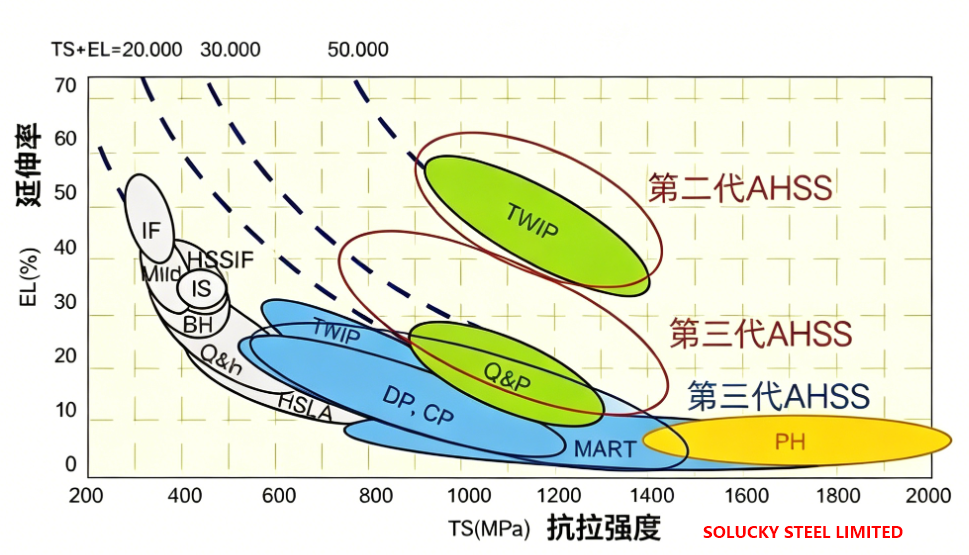
一、Material Basics: What is Dual-Phase(DP) Steel?
1.1 Core Principle
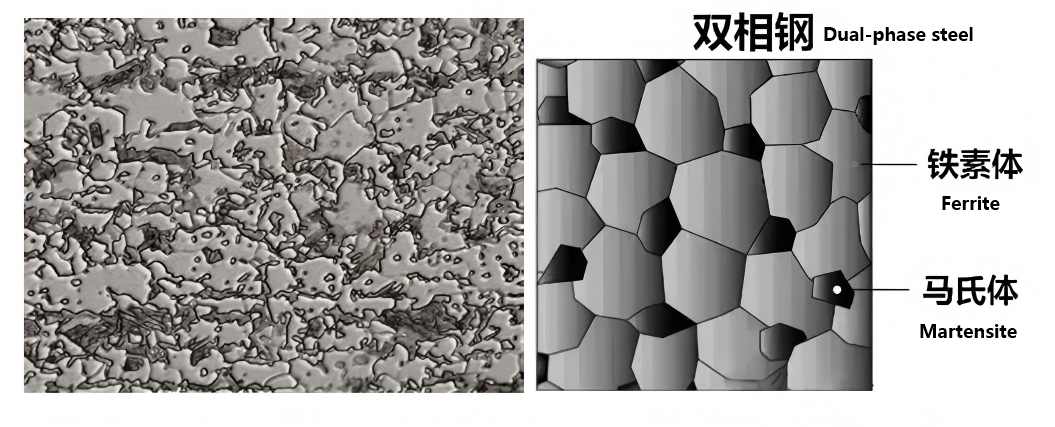
The microstructure of duplex steel consists of a soft ferrite matrix and hard martensite islands. The martensite is dispersed in the form of islands on the ferrite matrix. This "sponge + stone" structure enables it to possess the following characteristics simultaneously:
• Excellent ductility and formability provided by ferrite
• High strength and deformation resistance provided by martensite
1.2 Grade Naming Convention
|
Prefix / Suffix |
Meaning |
|
HC |
Flat products of high strength for cold forming |
|
B |
Baosteel proprietary prefix (enterprise standard) |
|
XXX/YYY |
Minimum Yield Strength / Minimum Tensile Strength (Unit: MPa) |
|
DP |
Cold-rolled dual-phase steel substrate(CR DP steel substrate) |
|
DPD |
Hot-dip galvanized dual-phase steel substrate (HDG DP steel substrate) |
|
+Z |
Hot-dip pure zinc coating |
|
+ZF |
Hot-dip galvannealed coating(GA coating) |
II. Key Properties: Full Series Parameter Comparison Table
2.1 Chemical Composition (Ladle Analysis, Mass Fraction %)
All grades adopt a basic C-Si-Mn composition system. Trace alloying elements such as Nb, Ti, Cr and Mo are added to refine grains and improve hardenability. The total amount of alloy elements does not exceed 1.5%.
|
Grade |
C≤ |
Si≤ |
Mn≤ |
P≤ |
S≤ |
|
HC250/450DP |
0.15 |
0.6 |
2.5 |
0.040 |
0.015 |
|
HC300/500DP |
0.15 |
0.6 |
2.5 |
0.040 |
0.015 |
|
B340/590DP |
0.15 |
0.9 |
2.5 |
0.040 |
0.015 |
|
HC340/590DP |
0.15 |
0.9 |
2.5 |
0.040 |
0.015 |
|
B420/780DP |
0.18 |
0.9 |
2.5 |
0.040 |
0.015 |
|
HC420/780DP |
0.18 |
0.9 |
2.5 |
0.040 |
0.015 |
|
HC550/980DP |
0.23 |
1.0 |
3.0 |
0.040 |
0.015 |
|
HC820/1180DP |
0.23 |
1.0 |
3.0 |
0.040 |
0.015 |
|
HC1000/1470DP |
0.28 |
1.0 |
3.0 |
0.040 |
0.015 |
The chemical composition of hot-dip galvanized DPD+Z seriesis exactly the same as that of the corresponding cold-rolled DP steel, with only an additional surface coating applied.
2.2 Mechanical Properties at Room Temperature (Core Parameters)
The data below are test results of transverse P17 specimens in accordance with GB/T 228.1-2021, applicable to regular gauges with thickness ranging from 0.7 mm to 2.5 mm.
|
Grade |
Yield Strength Range (MPa) |
Tensile Strength, min. (MPa) |
Elongation after Fracture A50, min. (%) |
Typical Yield-to-Tensile Ratio |
|
HC250/450DP |
250~320 |
450 |
28 |
0.56 |
|
HC300/500DP |
290~390 |
490 |
26 |
0.59 |
|
B340/590DP |
340~500 |
590 |
16 |
0.58 |
|
HC340/590DP |
340~440 |
590 |
22 |
0.58 |
|
B420/780DP |
420~590 |
780 |
14 |
0.54 |
|
HC420/780DP |
420~550 |
780 |
15 |
0.54 |
|
HC550/980DP |
550~720 |
980 |
9 |
0.56 |
|
HC820/1180DP |
820~1150 |
1180 |
5 |
0.70 |
|
HC1000/1470DP |
1000~1300 |
1470 |
5 |
0.68 |
2.3 Mechanical Properties of Hot-Dip Galvanized DPD+Z Series
The mechanical properties of the hot-dip galvanized series are basically consistent with those of the cold-rolled substrate, except that the elongation after fracture decreases slightly by 1~2%.
|
Grade |
Yield Strength Range (MPa) |
Tensile Strength, min. (MPa) |
Elongation after Fracture A50, min. (%) |
Typical Yield-to-Tensile Ratio |
|
HC340/590DPD+Z |
340~440 |
590 |
18 |
0.58 |
|
HC420/780DPD+Z |
420~550 |
780 |
14 |
0.54 |
|
HC550/980DPD+Z |
550~720 |
980 |
8 |
0.56 |
|
HC820/1180DPD+Z |
820~1150 |
1180 |
5 |
0.70 |
2.4 Interpretation of Key Properties
•Yield-to-tensile ratio: Generally ranges from 0.54 to 0.70, much lower than that of conventional high-strength steel (0.75 to 0.90). A lower yield-to-tensile ratio means smaller stamping springback and higher dimensional accuracy of parts.
•Work hardening rate: In the low-strain zone (2% - 3%), the work hardening rate can reach 140 - 220 MPa, effectively dispersing stress during the forming process and avoiding local necking.
•Bake hardening property: After baking at 170°C for 20 minutes, the yield strength can increase by 30 - 150 MPa, significantly enhancing the part's service strength.
•Strain rate sensitivity: Under crash conditions (strain rate: 10²–10³ s⁻¹), the yield strength rises by 10%–30%, and the collision energy absorption rate is over 50% higher than that of ordinary low-carbon steel.
三、 Production Process: How to Manufacture Duplex Steel?
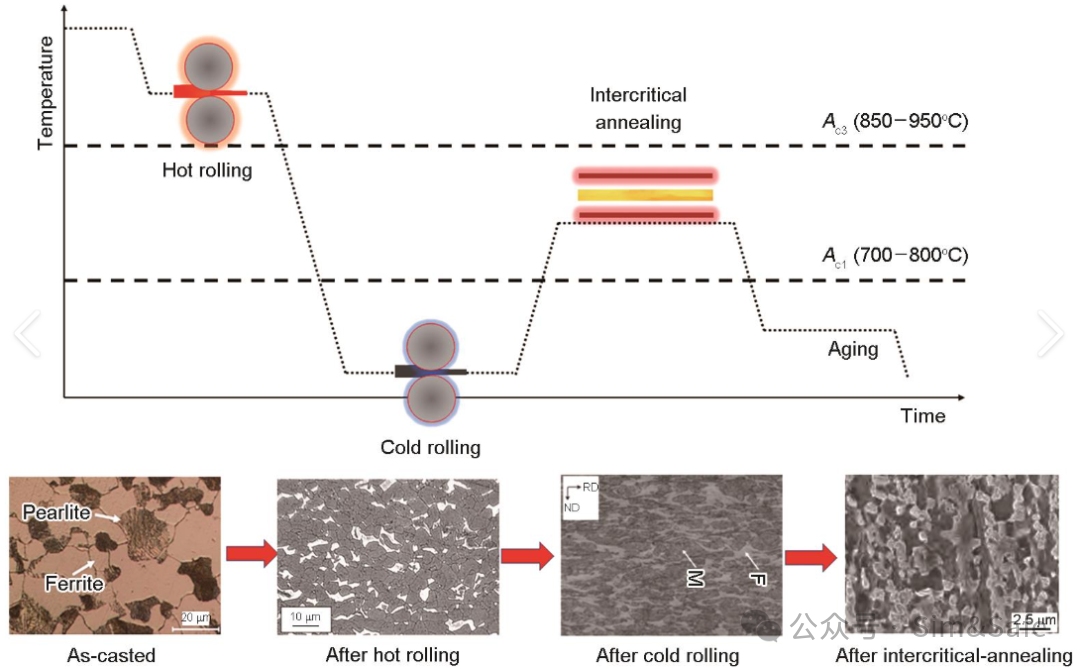
3.1 Production Flow of Cold-Rolled Dual-Phase Steel
Hot metal pretreatment → Converter steelmaking → Continuous casting → Hot rolling → Pickling → Tandem cold rolling → Continuous annealing → Temper rolling → Finished product
Core Procedures of Continuous Annealing:
•Heating: Heat up to the two-phase region of 780–870 ℃ at a rate of 5–15 ℃/s.
•Soaking: Hold for 30–120 seconds to fully homogenize austenite.
•Slow cooling: Cool to 650–700 ℃ at 1–5 ℃/s to form 50%–80% ferrite.
•Rapid cooling: Cool to 200–300 ℃ at 10–40 ℃/s, and the residual austenite transforms into martensite.
•Over-Treatment: Hold at 200-300℃ for 60-300 seconds to eliminate internal stress
The corresponding relationship between martensite content and strength:
•DP450/500: Martensite content 10%–20%
•DP590: Martensite content 20%–30%
•DP780: Martensite content 30%–50%
•DP980: Martensite content 50%–70%
•DP1180/1470: Martensite content 70%–90%
3.2 Production Differences of Hot-Dip Galvanized Dual-Phase Steel (DPD+Z)
The production of hot-dip galvanized duplex steel is carried out on a continuous hot-dip galvanizing line. The key differences are as follows:
•The temperature of the zinc pot is approximately 460℃. After the steel strip exits the zinc pot, it needs to be rapidly cooled to below the Ms point at a rate of ≥30℃/s.
•The steel demands higher hardenability. Trace boron (B) is commonly added to improve this property.
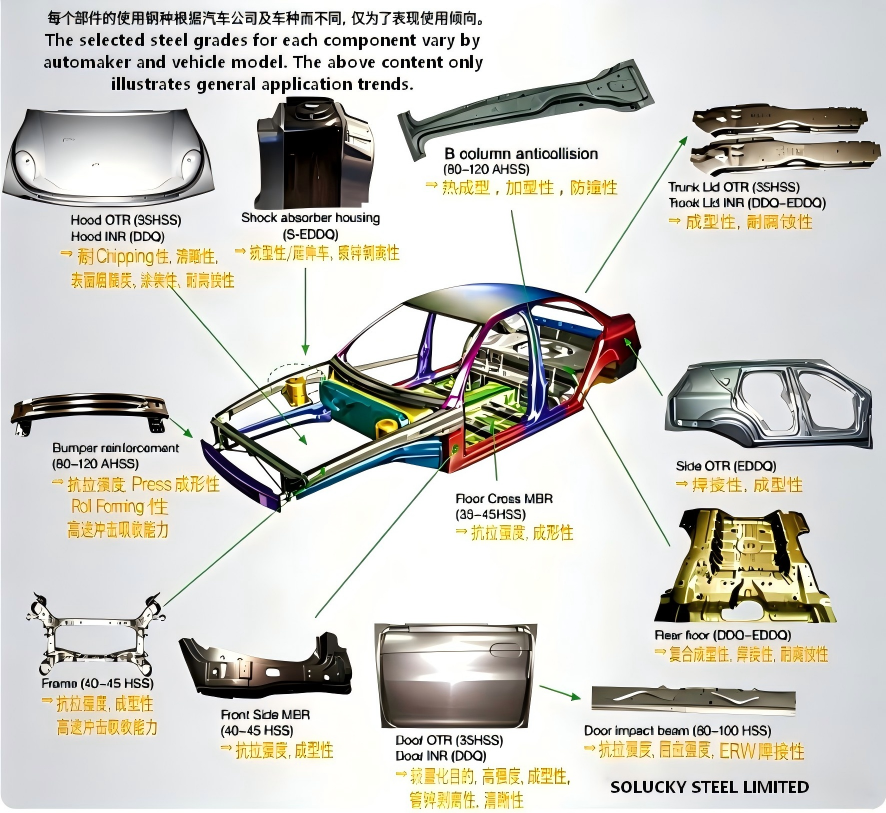
四、 Industrial Application: Where Dual-Phase Steel is Used in Automobiles
4.1 Typical Applications by Strength Grade
|
Strength Grade |
Typical Application Positions |
Core Functions |
Weight Reduction Effect |
|
DP450/500 |
Inner door panel, trunk lid inner panel, hood inner panel, floor reinforcement |
Panel reinforcement, secondary structural parts |
10%~15% |
|
DP590 |
Front side member, rocker beam, B-pillar reinforcement, door impact beam, seat frame |
Main load-bearing structural parts, safety components |
15%~20% |
|
DP780 |
A-pillar reinforcement, B-pillar inner panel, front crash crossmember, bumper reinforcement |
Key safety components, high-load-bearing structural parts |
20%~25% |
|
DP980 |
Rocker reinforcement, roof crossmember, chassis suspension bracket |
Ultra-high load-bearing safety components |
25%~30% |
|
DP1180/1470 |
Front and rear impact beams, B-pillar reinforcement, rocker beam |
Extreme load-bearing safety components |
30%~35% |
4.2 Special Applications in New Energy Vehicles
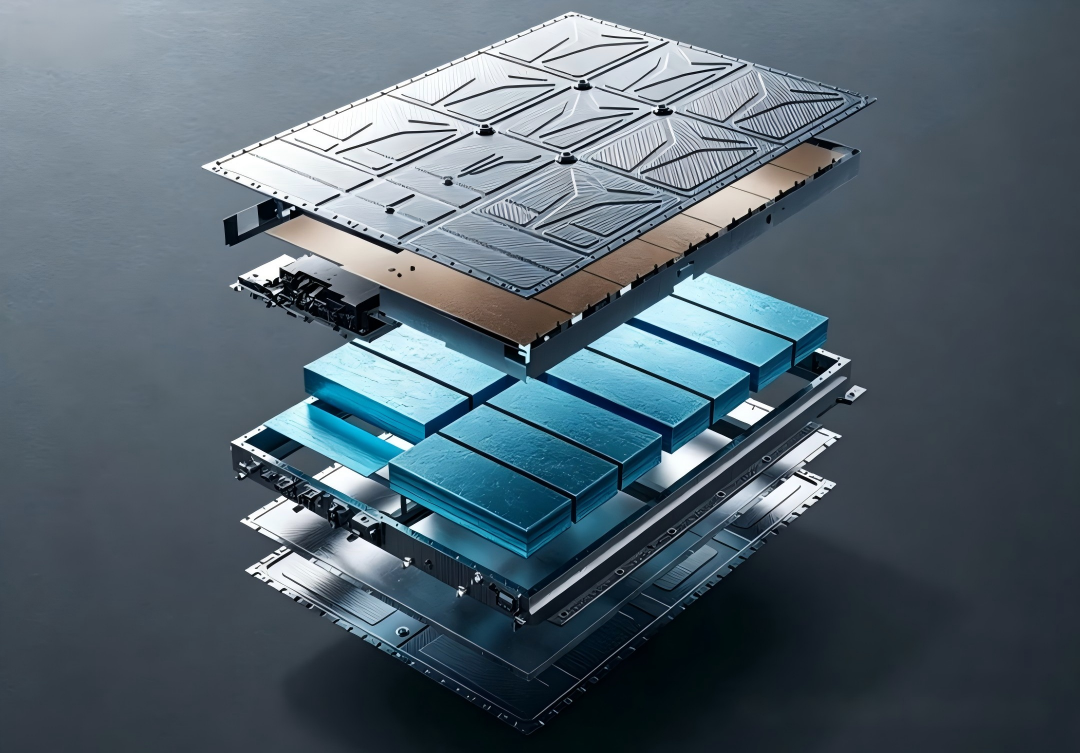
•Battery pack system: HC550/980DPD+Z and HC820/1180DPD+Z are the mainstream materials for battery pack housings and frames. The zinc layer provides 1440 hours of neutral salt spray protection capability, meeting the requirements for electrolyte corrosion
•Body structure: HC1000/1470DP (Giga steel) has been adopted by multiple models of Changan Mazda, BYD and other brands. It achieves a weight reduction of 15%–20% compared with DP980 steel.
•Chassis system: Hot-dip galvanized DP steel is used for suspension brackets, drive shafts and other parts, with corrosion resistance qualified for a service life of over 10 years.
4.3 Other Industrial Applications
•Construction machinery: Excavator arms, loader structural parts
•Home appliances: Washing machine inner drums, air conditioner compressor brackets
•Rail transit: Metro car body components, seat frames
五、 CAE Simulation: Key Points for Dual-Phase Steel Simulation
Dual-phase steel simulation mainly falls into two categories: stamping forming simulation and crash safety simulation. Commonly used software includes LS-DYNA, Abaqus, AutoForm and PAM-STAMP.
5.1 Main Material Models in LS-DYNA
|
Material ID |
Model Name |
Application Scenarios |
|
*MAT_024 |
Piecewise Linear Plasticity Model |
Over 90% of engineering applications, for stamping and crash simulation |
|
*MAT_123 |
Plasticity Model with Failure |
Crash failure prediction |
|
*MAT_224 |
GISSMO Damage Model |
High-precision fracture simulation |
5.2 Key constitutive parameters - Basic elastic parameters (applicable to all duplex steels)
• Elastic modulus E: 206 GPa
• Poisson's ratio PR: 0.3
• Density ρ: 7.85 × 10⁻⁹ t/mm³
Cowper-Symonds strain rate model parameters
Formula: σ_dyn = σ_stat × [1 + (ε̇/C)^(1/P)]
|
Material |
C(s⁻¹) |
P |
Data Source |
|
DP590 |
65000 |
4.5 |
CATARC test data |
|
DP780 |
80000 |
4.8 |
Central Iron and Steel Research Institute |
|
DP980 |
100000 |
5.0 |
Baosteel technical documents |
5.3 Notes on Simulation
1. True stress-true plastic strain curves must be adopted instead of engineering stress-strain curves.
2. The strain rate effect must be considered in the collision simulation; otherwise, the material strength and energy absorption capacity will be underestimated.
3. The mesh size of critical areas shall be controlled within 3~5 mm, as failure prediction is highly sensitive to mesh size.
4. The hot-dip galvanized coating has a minor impact on mechanical properties and can generally be ignored; however, the coating effect should be considered in the welding simulation.
5. All parameters shall be derived from actual material test data to avoid deviations caused by general parameters.
VI. Conclusion
Dual-phase steel features an excellent combination of strength and ductility, making it an indispensable core material for the automotive industry. Our full product lineup covers grades from low-strength DP450 to ultra-high-strength DP1470, which can satisfy the application requirements for all automotive parts ranging from body panels to critical safety components.
With the increasing demands for lightweighting and safety in new energy vehicles, higher strength (above 1500 MPa) and better corrosion resistance dual-phase steel will become the future development direction. At the same time, the continuous advancement of CAE simulation technology will further promote the application expansion of dual-phase steel, helping automakers achieve the goal of "lighter, safer, and more economical".
•The typical coating weight ranges from 60 to 120 g/m², which endows the steel with outstanding corrosion resistance.


