


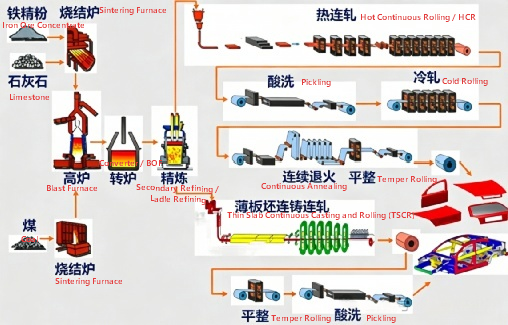
Driven by the dual trends of automotive electrification and upgraded crash safety standards, vehicle lightweighting and impact protection have become two equally critical core objectives. Featuring ultra-high tensile strength, high-precision forming capacity and remarkable weight reduction effects, press hardening steel (PHS) has turned into the standard material for passenger cabin safety structures of modern automobiles. Its application proportion and strength grade directly define the upper limit of vehicle crash safety and lightweight performance.
After more than a decade of technological catch-up, domestic steel manufacturers have realized fully localized mass production of the complete PHS product spectrum. Local supply covers grades ranging from the entry-level 1500 MPa up to the top-tier 2000 MPa variants. In niche fields such as hydrogen embrittlement resistance and high toughness, domestic products have even reached world-leading standards. This paper systematically sorts out the full technical system of PHS, covering material grades, mechanical properties, manufacturing processes, vehicle applications, CAE simulation modeling and failure countermeasures, so as to deliver comprehensive references for practitioners in the automotive and steel material industries.
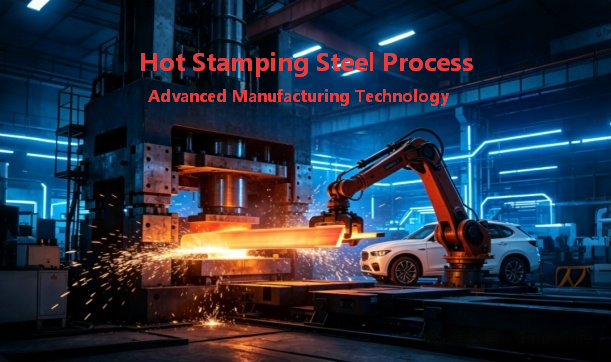
一、Basic Concept and Industry Positioning of Press Hardening Steel
Press Hardening Steel (PHS), also referred to as hot stamping steel, is a category of ultra-high-strength boron-alloyed steel specially developed for the hot stamping forming process. Its core working principle is as follows: the steel blank is heated to the austenitizing temperature range of 880~950°C, rapidly transferred into dies, and quenched synchronously during forming. This transforms the high-temperature austenite metallographic structure into hard and fully martensitic microstructure, producing ultra-high-strength components with tensile strength exceeding 1500 MPa.
This technology perfectly addresses long-standing industry pain points of conventional cold-stamped ultra-high-strength steel, namely poor formability, severe springback and low dimensional accuracy. It serves as the core material solution to achieve both lightweight design and superior crash safety for current automotive bodies. Compared with cold-stamped steel of equivalent strength grades, hot-stamped components deliver a 20%~30% weight reduction. Meanwhile, dimensional accuracy can be controlled within ±0.5 mm, with springback angles less than
二、Main Brand Series and Core Mechanical Properties
2.1 Domestic Main Steel Plant Grade System
Domestic hot-rolled steel has achieved full-scale self-production autonomy. Leading steel enterprises such as Baosteel, Ansteel (Baoshan Steel), MaSteel, and Shougang have all formed complete product matrices, with strength ranging from 1000MPa to 2200MPa. In terms of anti-hydrogen embrittlement and high toughness, they have reached international advanced levels, serving as the main supply sources for both domestic brands and joint venture brands.
(1) General reference grade: 22MnB5
• Definition: The benchmark composition system for global hot stamping steel. All domestic steel mills have corresponding mass production versions. It is the most industry-wide applicable 1500MPa grade basic grade, and it is also the most widely used hot stamping steel in the automotive industry.
• Typical composition: C 0.22%, Mn 1.2%, B 0.002% - 0.005%. Titanium is added to fix the nitrogen element and prevent grain boundary embrittlement.
• Supply condition: Ferrite + Pearlite structure, tensile strength approximately 600 MPa, elongation ≥ 18%
• After hot stamping: All martensite structure, yield strength 950/1200 MPa, tensile strength 1300/1650 MPa, hardness 470~510 HV
•Advantages: Wide process window, lowest cost, most mature industrial chain. It is the preferred material for most entry-level hot stamping parts in China.
(2) Baosteel Co., Ltd. —— The Most Comprehensive Commercial Product Range
Baosteel is a benchmark in hot stamping steel technology in China. Its products cover both cold-rolled and hot-rolled base plates, as well as aluminum-silicon coating and bare plates. It complies with the enterprise standards Q/BQB 409-2023 (for cold-rolled) and Q/BQB 315-2023 (for hot-rolled), and is the most widely used brand for component manufacturers in China.
Main brand name of cold-rolled hot stamping steel:
|
Grade |
Yield Strength after Hot Stamping (MPa) |
Tensile Strength after Hot Stamping (MPa) |
Elongation A50 (%) |
Yield-to-Tensile Ratio |
Positioning & Typical Applications |
|
HC800/1000HS |
≥800 |
≥1000 |
≥6 |
~0.80 |
Medium-strength high-toughness grade, equivalent to Ductibor 1000. Applied to crash energy-absorbing zones and variable-strength soft zones, compatible with laser tailor welding of high-strength grades. |
|
HC950/1300HS |
≥950 |
1300~1600 |
5~7 |
~0.73 |
1300 MPa general-purpose grade. Suitable for structural parts requiring moderate toughness, such as seat cross members and roof cross beams. |
|
B1500HS |
1050~1250 |
1500~1700 |
5~8 |
~0.78 |
Benchmark 1500 MPa grade with the largest domestic market share. Used for core safety components including A/B pillars, sill beams and crash beams. |
|
B1800HS |
≥1500 |
1800~2000 |
4~6 |
~0.81 |
1800 MPa ultra-high strength steel. Adopted for extreme-load-bearing parts like battery pack cross members and door anti-collision beams. |
|
CR1300_2000HS |
≥1300 |
≥2000 |
4~5 |
~0.78 |
Top-tier 2000 MPa cold-rolled press hardening steel. Matches GISSMO failure model with dual parameters of 7%/10%, suitable for high-precision crash simulation. |
Special grade hot-rolled hot stamping steel:
•BR1200HS / BR1500HS: Hot-rolled base plate products, with a lower cost compared to cold-rolled base plates. The elongation at yield is ≥ 13%. Primarily used for strengthening components of commercial vehicle frames and chassis structural parts, balancing strength and economy.
• BQT800: Special heat-stressed bridge shell steel. After heat stamping, its tensile strength is ≥ 550 MPa and elongation is ≥ 21%. It can replace traditional cast bridge shells, achieving a weight reduction of over 30%.
(3) Ansteel Group (Bensteel) - Pioneer in Ultra-High Strength Steel Technology
Baoshan Steel and Bensteel are the first steel enterprises in China to achieve mass production of 2000MPa grade hot stamping steel. They have profound technical accumulation in the field of high-toughness hot stamping steel, and their products are widely used in northern car manufacturers and new energy brands.
• Standard series: A full range of aluminum-silicon coated hot-pressed steel at 1200MPa, 1500MPa, and 1800MPa grades, with performance benchmarking against international counterparts. It is widely used in body structure components of both domestic and foreign brands.
• 2000MPa ultra-high-strength hot stamping steel: Jointly developed with Northeastern University in 2017 and achieving the world's first batch production. After hot stamping, the tensile strength is ≥ 2000MPa, the elongation after fracture is ≥ 7%, and the three-point bending angle is ≥ 60°. It has been widely applied to models such as BAIC New Energy, etc., reducing the weight of parts by 10% to 15% compared to 1500MPa grade.
• AluSlim® High Toughness Series: An upgraded product jointly launched by Northeastern University. It includes four grades: AluSlim® 1000, 1500, 2000, and 2200. Under the same strength level, its toughness is 10% to 20% higher than that of traditional products. Among them, AluSlim® 2200 is the current highest-strength aluminum-silicon clad hot stamping steel in the world, with a tensile strength of 2020 MPa and a three-point bending angle of 48.4°.
(4) MaSteel Co., Ltd. —— Special Technology Route for Resistance to Hydrogen Embrittlement
Ma Steel focuses on the problem of delayed cracking in ultra-high-strength hot stamping steel, and has launched differentiated anti-hydrogen embrittlement products, precisely addressing the hydrogen embrittlement risk of high-strength steel in new energy vehicles:
• 2000IH Anti-Hydrogen-Induced Brittle Fracture Hot Forming Steel: Jointly developed with Ideal Automobile and Tsinghua University, the core focus is on high strength and toughness combined with low hydrogen-induced brittleness risk. After hot stamping, the tensile strength reaches the 2000MPa level, and the energy absorption capacity is 78% higher than that of traditional 2000MPa level, approaching the toughness level of 1500MPa; verified through an accelerated test in an acidic environment with pH=1 for 120 hours, the anti-hydrogen-induced brittleness ability reaches the level of traditional 1500MPa, which is more than 5 times that of traditional 2000MPa products, solving the industry pain point of hydrogen-induced delayed cracking in ultra-high strength steel.
(5) Representative products of other major steel mills
• Shougang Co., Ltd.: It possesses a full range of cold-rolled aluminum-silicon coated hot-pressed steel with 1500MPa and 1800MPa grades. The product size accuracy and coating stability are excellent, suitable for large and complex parts such as door rings and integrated threshold beams. It is also used in conjunction with many major domestic car manufacturers.
• Pansteel Vanit: Leveraging its abundant vanadium and titanium resources, it develops micro-alloyed hot stamping steel. Products at the 1500MPa grade have finer grains and outstanding fatigue performance. They are mainly supplied to the commercial vehicle and passenger vehicle markets in the southwestern region.
• Rizhao Steel: Specializes in hot-rolled base plate hot-formed steel with thickness ranging from 1.0 to 3.0 mm. It has excellent expansion performance and is suitable for chassis traveling mechanism parts such as triangular arms, longitudinal arms, and swing arms. It can replace cold-rolled products of the same specification to reduce costs.
|
Grade |
Yield Strength Rp0.2 (MPa) |
Tensile Strength Rm (MPa) |
Elongation after Fracture A80 (%) |
Yield-to-Tensile Ratio |
Core Characteristics & Applications |
|
Usibor® 1500 |
≥1050 |
≥1400 |
5~7 |
~0.75 |
First-generation benchmark product, the world’s most widely used 1500 MPa press hardening steel. Suitable for anti-intrusion components such as A/B pillars, sill beams and door anti-collision beams. |
|
Usibor® 1500P |
1050~1200 |
1400~1600 |
5~6 |
~0.78 |
Optimized Al-Si coated variant with enhanced coating adhesion and improved weldability, compatible with tailor-welded blank processes. The letter "P" stands for Premium grade. |
|
Usibor® 2000 |
≥1400 |
≥1800 |
4~5 |
~0.78 |
Second-generation product with roughly 30% higher strength than the 1500 MPa grade. Its bending angle exceeds 40°, enabling an extra 10%~15% weight reduction. Applied to body structural parts with ultra-high safety requirements. |
Supplementary Explanation:
All Usibor grades are available in an Al-Si (aluminum-silicon) coating version, which can prevent oxidation and decarburization during heating, eliminating the need for a subsequent shot blasting process.
The suffix "_HAZ" represents a specialized material model for the welding heat affected zone (Heat Affected Zone), which is used in simulations to model the mechanical behavior of the localized softened area after welding.
• Usibor 1500 corresponds to the European standard grade 22MnB5 (material code 1.5528), and their compositions and properties are basically the same.
- Ductibor® Series - Energy-absorbing High-Strength Hot Stamping Steel
|
Grade |
Yield Strength Rp0.2 (MPa) |
Tensile Strength Rm (MPa) |
Elongation after Fracture A80 (%) |
Yield-to-Tensile Ratio |
Core Characteristics & Applications |
|
Ductibor® 500 |
≥330 |
≥550 |
≥14 |
~0.60 |
Low-strength high-toughness variant that retains excellent ductility after hot stamping. It is adopted in crash energy-absorbing zones and tailor-welded with Usibor blanks. |
|
Ductibor® 500P |
330~380 |
550~650 |
≥12 |
~0.62 |
Optimized coated grade compatible with tailor-welded blank technology for more stable weld performance, commonly used for energy-absorbing components such as front longitudinal beams. |
|
Ductibor® 1000 |
≥800 |
≥1000 |
≥6 |
~0.80 |
Second-generation medium-strength press hardening steel. Its strength doubles compared with 500 MPa grade while maintaining high toughness. Replacing Ductibor 500 can achieve a weight reduction of over 25%. |
(3) Usibor Transition Series — Graded Strength Transition Material
The Usibor Transition HT series is a transition zone material specially developed for variable-strength hot stamping. By controlling the cooling rate, a mixed martensite-bainite microstructure is formed to deliver continuous gradient strength distribution, which prevents stress concentration caused by abrupt property changes between hard zones and soft zones.
|
Grade |
Tensile Strength Grade (MPa) |
Microstructural Characteristics |
Functional Positioning |
|
Usibor Transition HT800 |
~800 |
Mixed martensite and bainite |
High-strength transition zone, connecting 1500 MPa hard zones and medium-strength zones |
|
Usibor Transition HT700 |
~700 |
Predominantly bainite with minor martensite |
Medium-strength transition, balancing sufficient strength and toughness |
|
Usibor Transition HT550 |
~550 |
Bainite plus ferrite |
Medium-low strength transition with priority on toughness |
|
Usibor Transition HT400 |
~400 |
Mainly ferrite and pearlite |
Low-strength soft zone, mainly serving for energy absorption |
This series of materials is mainly applied to components such as B-pillars and floor beam frames, achieving a performance gradient design of "resisting intrusion from the top and absorbing energy from the bottom". It is the core material foundation of the variable-strength hot stamping technology.
2.3 Other Common Brands and Special Materials in the Automotive Industry In addition to the two major systems mentioned above, the automotive industry also has a number of distinctive brands and specialized materials that are frequently used in high-frequency applications, covering special performance requirements and high-precision engineering scenarios:
• Docol 1500DP: A product from Swedish SSAB Company, belonging to the hot stamping grade of dual-phase steel, it combines high strength with certain cold formability, and is commonly used for parts with relatively simple shapes and additional requirements for formability in crash protection
• BTR165: A 1650MPa hot stamping boron steel from domestic steel mills,对标ing the upgraded version of Usibor 1500, with slightly higher strength than the conventional 1500MPa grade, and having a more favorable cost, widely used in self-owned commercial vehicles and entry-level passenger cars
• B1500HS_HAZ / B1800HS_HAZ / Usibor_HAZ series: Specialized material cards for welding heat affected zones, essential material parameters for crash simulation. Due to the effect of welding heat cycles, martensite in the heat affected zone undergoes tempering softening, with hardness typically 15% to 30% lower than the base material, being a high-risk weak area for structural failure, and must be assigned separately in the simulation to ensure calculation accuracy
• 1500MPa grade galvanized hot stamping steel: Each steel mill has a corresponding mass production version, developed for high-corrosion environment vehicles, combining high hot stamping strength with the cathodic protection ability of the galvanized layer, mainly used in chassis components and bottom structure components of the vehicle body.
三、Core Process System of Hot Stamping
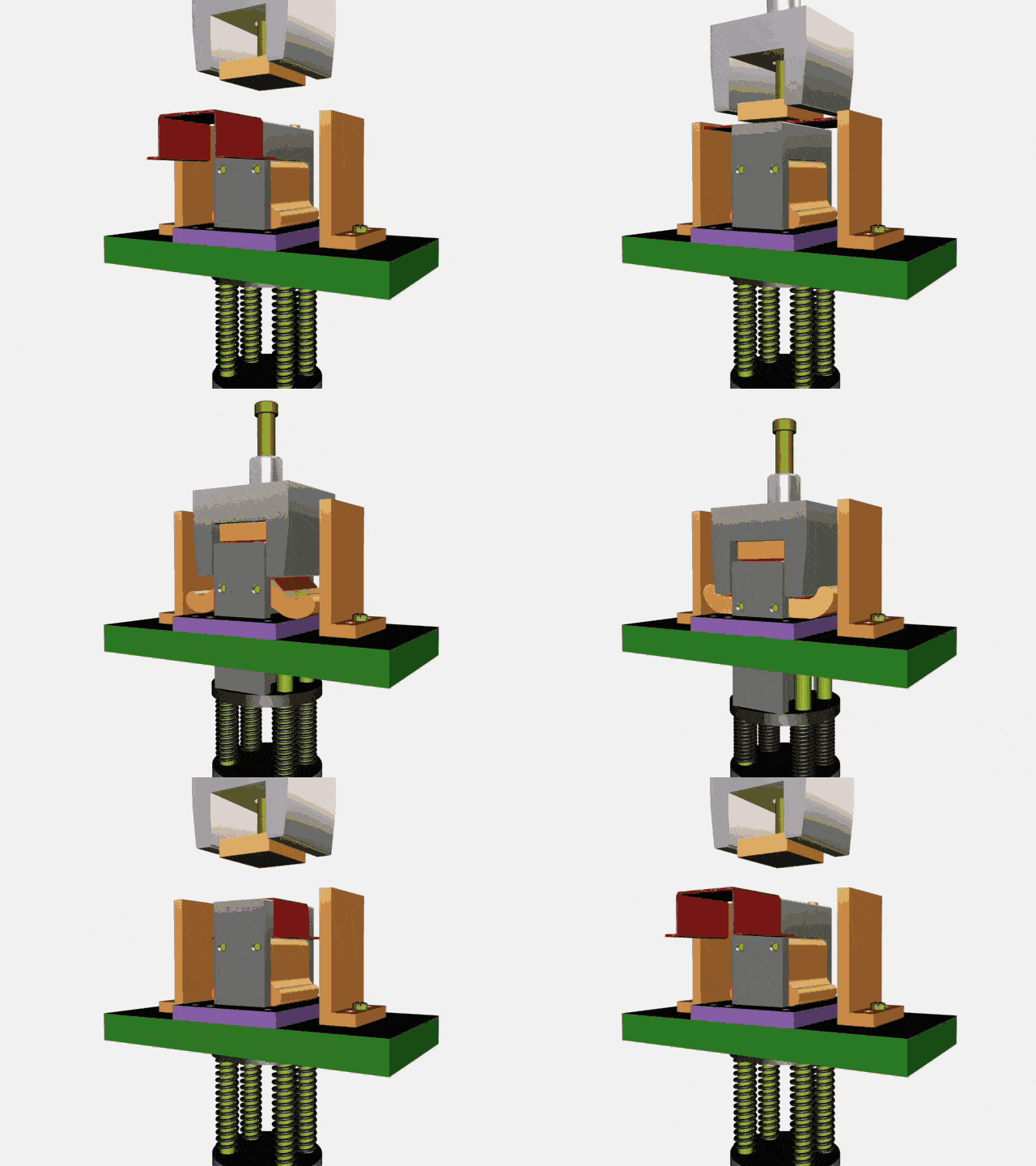
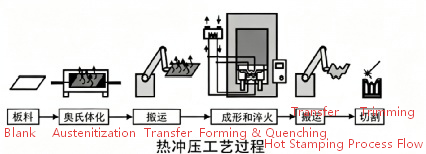
3.1 Basic Process Flow Standard Direct Hot Stamping Process consists of five core steps:
1. Material Cutting Preparation: Cut the sheet material according to the part dimensions, remove burrs, and pre-drill holes if necessary.
2. High Temperature Heating: Send the red-hot sheet material to the bottom-roller heating furnace and heat it to 880-950℃, maintaining the temperature for 3-5 minutes to fully austenitize the steel plate.
3. Rapid Transfer: The mechanical arm transfers the red-hot sheet material from the furnace to the stamping machine within a time control of 5 seconds or less to prevent excessive temperature drop.
4. Stamping and Quenching: The mold closes to complete the forming, and the internal cooling water channels of the mold quickly remove the heat. The cooling rate is ≥ 27℃/s, and the holding pressure is maintained for 5-10 seconds to complete the martensitic phase transformation.
5. Post-Treatment: After demolding, perform laser trimming and punching. For aluminum-silicon coated products, no shot blasting is required, while the bare sheet needs shot blasting to remove the oxide layer.
3.2 Classification of Main Process Routes
(1) Direct Hot Stamping Process
The sheet material is directly heated and formed into shape in one step. The process is simple and efficient, suitable for parts with relatively simple shapes, such as bumper crossbars and door impact beams.
(2) Indirect Hot Stamping Process
First, complete about 90% of the pre-forming through cold stamping, then heat and final hot stamping and quenching. This is suitable for parts with complex shapes and large drawing depths (such as the central channel), which can reduce the deformation in the hot stamping stage and reduce the cracking risk.
(3) Variable Strength Hot Stamping Process
Through mold zone temperature control technology, different areas of the part are quenched at different cooling rates to form a gradient structure and properties. A typical application is the B-pillar: the upper part is rapidly cooled to obtain 1500MPa martensitic resistance to intrusion, and the lower part is slowly cooled to obtain 800-1000MPa bainite structure for energy absorption, which can significantly optimize the side impact performance.
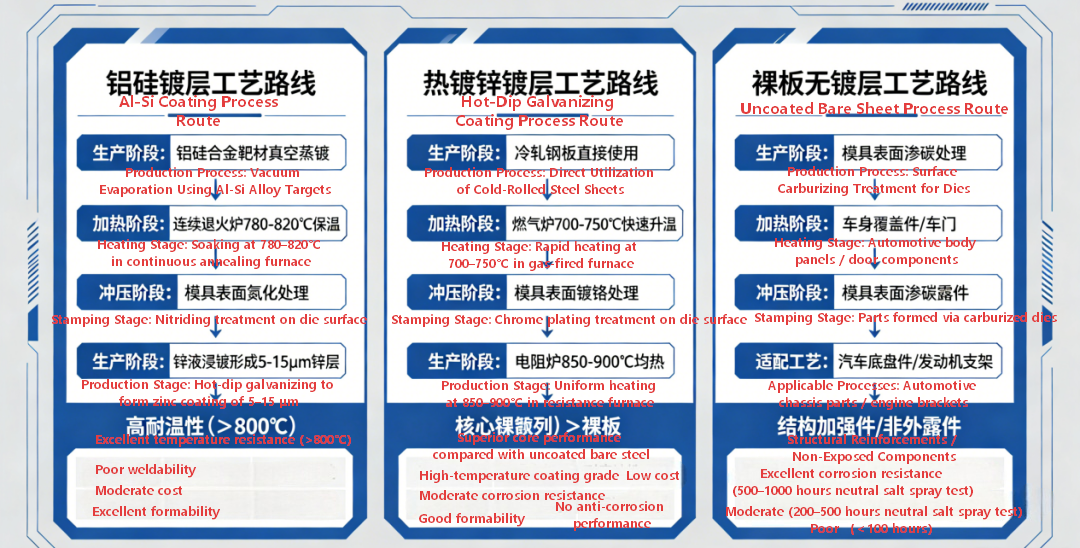
3.3 Surface Coating System
|
Coating Type |
Representative Product |
Core Function |
Advantages & Disadvantages |
|
Al-Si Coating (Al-Si) |
Usibor-AS, B1500HS+AS |
Prevent high-temperature oxidation and decarburization, shot blasting free |
Most mature process; no cathodic protection, prone to corrosion where coating is damaged. Aluminum entering welds during welding reduces joint strength, requiring laser coating removal. |
|
Hot-Dip Galvanized Coating (GI) |
Usibor-AS, B1500HS+AS |
Combine high-temperature protection and cathodic anti-corrosion performance |
Only applicable to indirect hot stamping with risk of Liquid Metal Embrittlement (LME). |
|
Uncoated Bare Steel (No Coating) |
Uncoated 22MnB5 Blank |
Lowest material cost |
Oxide scale forms after heating, shot blasting is mandatory; poor surface quality and high risk of decarburization. |
四、Expansion of Industrial Applications and Automotive Whole Vehicle Applications
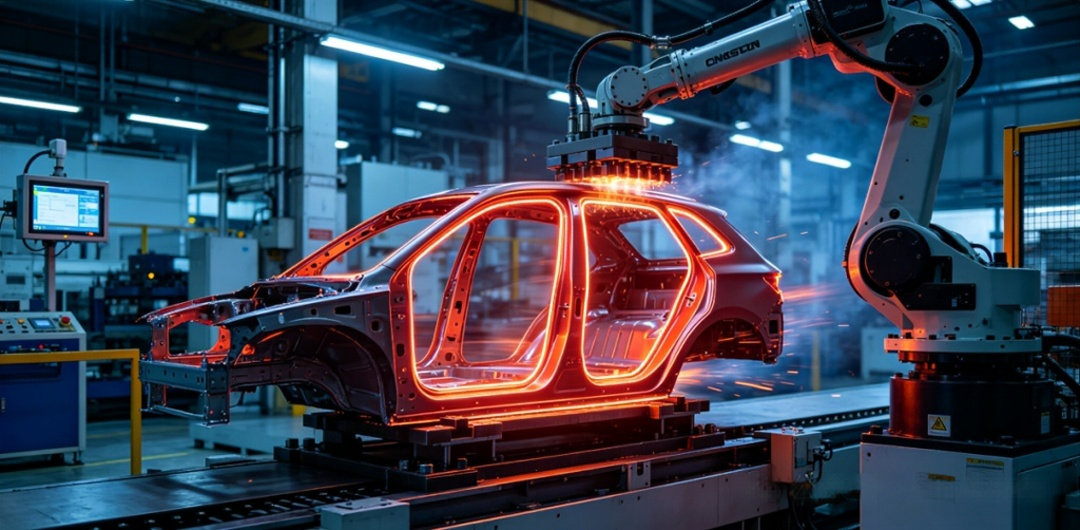
4.1 Typical Application Areas of Hot Stamping Steel in Automobile Body: Hot stamping steel has become a standard material for modern automotive safety bodies. It is mainly used in the "safety cage" structure of the passenger compartment. Typical application areas include:
1. Frontal collision protection: Front bumper beam, front longitudinal beam reinforcement section, A-pillar reinforcement plate
2. Side collision protection: B-pillar reinforcement plate, floor rail, door bumper beam, roof side beam
3. Top pressure resistance protection: Front roof crossbeam, rear roof crossbeam, A-pillar upper reinforcement plate
4. Bottom structure: Central aisle, seat crossbeam, battery pack lower housing reinforcement piece (for new energy vehicles)
4.2 Current Industry Application Status
• Application proportion continues to increase: The usage of hot-pressed steel in domestic mainstream fuel vehicles accounts for approximately 10% - 15% of the weight of the body panel. For new energy vehicles, due to the need for battery pack protection, the proportion has risen to 20% - 30%. Some high-end models even exceed 35%.
• Strength grades are constantly upgrading: Initially, 1500MPa was the main grade, gradually transitioning to 1800MPa and 2000MPa. Models such as Xiaomi YU7 and Zeke have already adopted 2000MPa grade hot-pressed steel as the door impact beam.
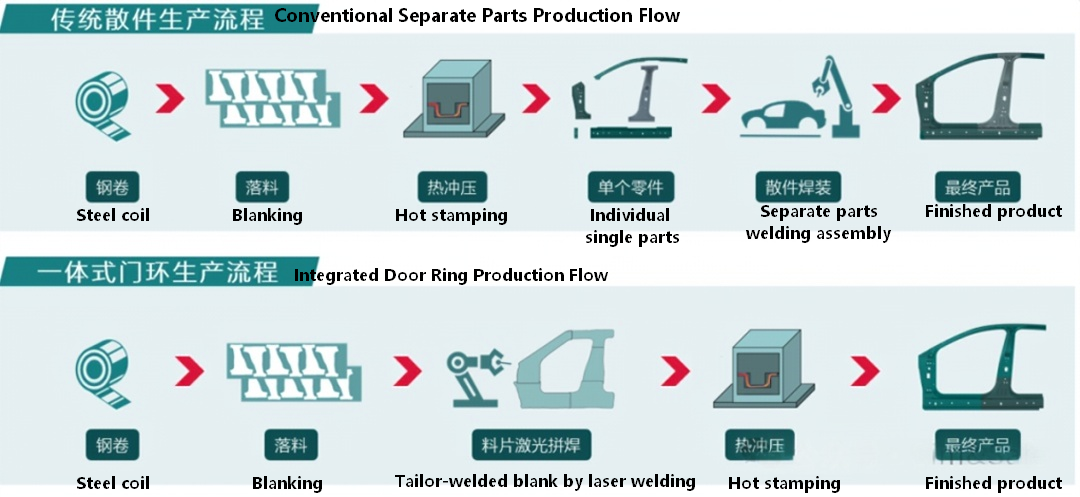
• Development of large-scale integrated parts: From individual parts to "door ring integrated forming" and "overall threshold beam" and other large-scale integrated hot-pressed parts, reducing welding processes and enhancing the overall structural integrity.
• Widespread adoption of variable strength design: Components such as B-pillars and longitudinal beams generally adopt gradient strength design to achieve a balance and optimization between intrusion resistance and energy absorption.

4.3 Typical Vehicle Application Cases
• Wuling Kaijie: The high-strength steel in the body accounts for 63%, and the heat-formed ultra-high-strength steel accounts for 10.1%. It is applied in over 10 key parts such as the front crossbeam, A/B beam reinforcement plates, and door impact beams.
• SAIC Audi E5 Sportback: It uses 1500MPa heat-formed steel to build a cage-shaped safety body, covering the impact beams, longitudinal beams, A/B/C beams, and bottom structure. During a frontal collision at 64 km/h, the intrusion of the driver's cabin is significantly reduced.
• Xiaomi YU7: It uses 2200MPa super-strong heat-formed steel, applied to the four-door impact beams and the embedded heat-expansion tubes in the A/B beams. The bearing capacity of the impact beam is increased by 37% to 52% compared to the 1500MPa grade.
五、Analysis of Simulation Application Expansion
5.1 Thermal Stamping Process Simulation
The hot stamping process is a typical "temperature - microstructure - stress" multi-field coupling problem. The mainstream simulation software includes LS-DYNA, AutoForm, Dynaform, PAM-STAMP, etc. The core simulation contents are:
• Temperature field simulation: Predict the temperature distribution throughout the entire process of sheet material heating, transfer, stamping, and holding pressure
• Phase transformation simulation: Based on the CCT curve, predict the phase transformation rates and final proportions of martensite, bainite, and ferrite under different cooling rates
• Formability simulation: Predict the cracking, wrinkling, and risk of thickness reduction during the hot stamping process
• Deformation recovery prediction: Predict the deformation recovery amount considering the phase transformation expansion effect and thermal expansion and contraction, guiding the compensation of mold surface shape
5.2 Material Modeling in Collision Simulation
(1) Base Material Constitutive Model
For hot stamping steel in collision simulations, an elastoplastic constitutive model is typically used, considering the strain rate effect (Cowper-Symonds model), and inputting the actual stress-strain curve. Due to the weak hardening ability of martensite after hot stamping, the stress-strain curve yields quickly and enters necking, with an elongation of only 5% to 7%.
(2) GISSMO Failure Model
GISSMO (Generalized Incremental Stress State Dependent Damage Model) is the most widely used ductile damage failure model in current automotive collision simulations and is also the default failure card for high-end grades such as CR1300_2000HS. The core principle of the model is:
• Describing the damage strain under different stress states based on the stress triaxiality and Lode angle parameters
• Using an incremental damage accumulation algorithm to consider the influence of loading path changes on failure
• Introducing damage evolution factors to simulate the stiffness degradation during crack propagation
The difference between 7% and 10% failure strain parameters:
• 7% GISSMO: Corresponding to the fracture criterion under high stress triaxiality (dominated by tension) conditions, the failure strain is lower and is more conservative
• 10% GISSMO: Corresponding to the fracture criterion under low stress triaxiality (dominated by shear) conditions, the failure strain is higher
• In actual simulations, the two parameters are continuously transitioned through the stress triaxiality function to fully cover failure modes such as tension, shear, and combined tension-shear
(3) HAZ Region Modeling
The welding heat-affected zone (HAZ) is the weak link in the failure of hot stamping steel structures. Due to the effect of the welding thermal cycle, martensite in the HAZ region undergoes tempering softening, with hardness decreasing by 15% to 30%, and the fracture risk is significantly higher than the base material. Precise simulation requires:
• Establishing a weld zone partition model to distinguish between the weld core, coarse-grained zone, fine-grained zone, and tempering zone
• Assigning different strength material cards to each zone (such as B1500HS_HAZ)
• Matching corresponding failure parameters to ensure that the failure location is consistent with the test
• Engineering experience: In the simulation of B1500HS weld points, failure occurs in the HAZ rather than the weld core in most cases
六、Common Failure Issues and Solutions in Production and Usage
6.1 Description of Material Fatigue Failure Issues:
The hot stamping parts are subjected to alternating loads (such as road bumps and vibrations) during vehicle operation. Fatigue cracks emerge at stress concentration areas and gradually expand, eventually leading to fracture. Although hot stamping martensitic steel has high static strength, its fatigue strength / tensile strength ratio (about 0.35 - 0.4) is lower than that of ordinary low-carbon steel, and it is more sensitive to stress concentration.
Causes:
1. Design factors: sudden changes in cross-section, sharp corners, small holes, etc., causing stress concentration
2. Process factors: the roughness of the laser-cut surface is large and there are many burrs, which become the source of fatigue cracks
3. Welding factors: the residual tensile stress around the weld point and the softening of the HAZ jointly reduce fatigue performance
4. Microstructure factors: the full martensitic structure has poor plasticity and the fatigue crack propagation rate is faster
Solutions:
1. Structural optimization: increase the radius of transition fillets, avoid sudden changes in cross-section, and reduce the stress concentration coefficient; place the opening holes away from the high-stress areas
2. Process improvement: optimize the laser-cutting parameters to improve the surface smoothness; perform grinding and deburring on the key edges
3. Surface strengthening: use shot peening to introduce surface residual compressive stress, which can increase fatigue strength by 20% - 30%
4. Welding optimization: control the welding heat input, reduce the width of the HAZ softening zone; perform local tempering after welding to eliminate residual stress
5. Material selection: for parts with high fatigue requirements, high toughness grades such as Ductibor 1000 can be selected, or variable strength design can be adopted; domestic grades can prioritize the use of vanadium-titanium microalloyed products, which have better fatigue performance after grain refinement
6.2 Description of Material Corrosion Failure Issues:
When hot stamping steel is exposed to corrosive environments such as moisture and salt fog, chemical or electrochemical reactions occur, resulting in a decline in the performance of the material's surface layer, a reduction in the cross-sectional area, and in severe cases, perforation failure. Products with aluminum-silicon coatings suffer from accelerated corrosion rates on the substrate when the coating is damaged due to the absence of cathodic protection.
Causes:
1. The aluminum-silicon coating only provides a barrier protection. Damaged areas cannot provide cathodic protection like the galvanized layer, and corrosion will spread to the substrate interior.
2. The laser-cut section lacks coating protection, making it a high-corrosion-prone area.
3. Components at the vehicle bottom are in prolonged contact with mud, snow salt, and have harsh corrosive conditions.
4. The internal cavities of the parts have incomplete electrocoat coverage, making them prone to cavity corrosion.
Solutions:
1. Upgrade coating system: In high-corrosive environments, prioritize using galvanized hot stamping steel, or adopt a composite coating scheme of aluminum-silicon + zinc.
2. Section protection: After laser cutting, apply glue or zinc-rich primer to the section for sealing treatment.
3. Structural optimization: Design drainage holes to prevent water accumulation in the internal cavities of the parts; reduce gap structures to prevent liquid accumulation.
4. Coating process optimization: Improve the uniformity of the electrophoretic paint film to ensure the internal cavity film thickness meets the standard; add PVC anti-cracking coating to key parts.
5. Process control: Ensure the integrity of the aluminum-silicon coating to prevent coating peeling during the stamping process; take anti-rust oil protection during transportation and storage.
6.3 Material Plastic Deformation Failure
Problem Description:
When subjected to collisions or extreme loads, the hot stamping parts undergo plastic deformation beyond the design expectations, resulting in structural instability and excessive intrusion of the passenger compartment, thereby affecting safety performance.
Causes:
1. Insufficient material strength: Insufficient cooling rate during quenching, forming bainite or ferrite soft phases, leading to actual yield strength being lower than the design value.
2. Inappropriate section design: Insufficient moment of inertia of the section, causing buckling instability under compression.
3. Welding failure: Premature fracture of weld points causing interruption of the structural force transmission path and sudden increase in local load.
4. Process defects: The parts have soft spots and uneven hardness, with the weak areas experiencing plastic deformation first.
Solutions:
1. Process control: Ensure that the cooling water channels of the molds are unobstructed, with a cooling rate of ≥ 27℃/s; Regularly inspect the hardness distribution of the parts to eliminate soft spots.
2. Structural reinforcement: Optimize the section shape, add ribs to enhance the anti-buckling ability; Use closed-sections instead of open-sections.
3. Material upgrade: When the load exceeds 1500MPa, upgrade to 1800MPa or 2000MPa grade hot stamping steel.
4. Quality inspection: Add hardness inspection on the production line to ensure full martensite transformation; Use three-dimensional scanning to monitor size and form position tolerances.
6.4 Material Cracking and Failure
Problem Description:
During the stamping production or service process, the parts exhibit macroscopic cracks, resulting in direct structural failure. According to the occurrence stage, it can be divided into two categories: stamping cracking and service cracking.
Causes and Solutions for Stampation Cracking:
1. Cracking during hot stamping process: Long transfer time of sheet material and low temperature lead to a decrease in plasticity, resulting in drawing cracking; Solution: Optimize the mechanical hand cycle, control the time from unloading to mold closing ≤ 5 seconds, and ensure the starting temperature of stamping ≥ 750℃
2. Cold bending cracking: Insufficient plasticity of martensite structure due to too small bending radius during subsequent bending process leads to cracking on the outer side; Solution: Increase the inner bending radius (≥ 3t), or locally heat and temper the bending area to enhance toughness
3. Edge trimming and punching cracking: Micro cracks are prone to occur at the stamping section of ultra-high strength steel, and are subsequently expanded under force; Solution: Use laser cutting instead of stamping, or optimize the stamping gap to reduce the core type of service cracking: Hydrogen-induced delayed cracking is the most representative failure mode for high-strength hot stamping steel above 1500 MPa:
• Problem Description: The part suddenly undergoes brittle fracture under static load below the yield strength after a period of time, without obvious plastic deformation, with suddenness and concealment
• Mechanism of occurrence: Hydrogen atoms infiltrate the steel during smelting, acid washing, electroplating, welding, etc., accumulate at stress concentration points, reducing the bond strength at grain boundaries, and ultimately causing intergranular cracking. The aluminum-silicon coating will hinder the escape of hydrogen, exacerbating the risk of hydrogen embrittlement
• High-risk areas: Laser cutting edge, around welding points, and areas with large stamping deformation
• Solution:
a. Material aspect: Optimize component design by adding micro-alloying elements such as Nb, V, and Ti to refine the grain structure and enhance the resistance to hydrogen embrittlement; for high-risk scenarios, directly select special anti-hydrogen embrittlement grades like 2000IH from Ma Steel
b. Process aspect: Perform low-temperature dehydrogenation annealing (holding at 170-200°C for 2-4 hours) after hot stamping; Control the quality of laser cutting to reduce micro-cracks at the edges
c. Environmental control: Avoid mold condensation to prevent the formation of condensate water and prevent hydrogen atoms from penetrating through water; Maintain a dry production environment
d. Structural design: Reduce the stress concentration coefficient and avoid areas where high stress and high hydrogen content overlap
6.5 Bending and Dimensional Accuracy Issues
Problem Description:
After the hot stamping parts are demolded, they undergo shape rebound, resulting in dimensional deviations and affecting assembly accuracy. Although the rebound in hot stamping is much smaller than that in cold stamping, it still cannot be ignored in large parts and variable-strength parts.
Causes:
1. Uneven cooling leads to uneven distribution of residual stress within the parts.
2. Different regions of variable-strength parts have different structures, and the difference in phase transformation expansion causes additional stress.
3. Inconsistent temperature distribution in the mold, with inconsistent local cooling rates.
4. Insufficient holding time, with the phase transformation not completing before demolding.
Solutions:
1. Mold compensation: Predict the rebound amount through hot stamping simulation and perform reverse compensation on the mold surface.
2. Process optimization: Appropriately extend the holding time (≥8s) to ensure complete martensitic transformation; optimize the layout of cooling water channels to ensure uniform cooling.
3. Parameter control: Stabilize process parameters such as sheet heating temperature, mold temperature, and clamping force to reduce fluctuations between batches.
4. Zone temperature control: Reasonably design the width of transition zones for variable-strength parts to avoid uneven rebound caused by sudden changes in performance.
七、 Summary and Future Trends
The hot stamping steel technology has evolved over the past 50 years, forming a complete strength spectrum ranging from 500MPa to above 2200MPa. It has continuously advanced from a uniform strength to a gradient performance and towards a more integrated and large-scale direction. Domestic steel enterprises have achieved a breakthrough from catching up to being on par, and even leading in some fields. In the 2000MPa level ultra-high strength, anti-hydrogen embrittlement, and high toughness sub-sectors, they have formed their own core technologies.
Driven by the dual forces of automotive electrification and the upgrading of safety standards, the application proportion and strength level of hot stamping steel will continue to increase. At the same time, it is necessary to recognize that the higher the strength of hot stamping steel, the more sensitive it is to hydrogen embrittlement, the more difficult the welding is, and the narrower the forming window. This poses higher requirements for material research and development, process control, and simulation accuracy. In the future, the industry will continuously optimize towards the goal of "higher strength + better toughness + better weldability + lower hydrogen embrittlement risk", promoting the development of hot stamping steel technology to a higher level.
1°.


