


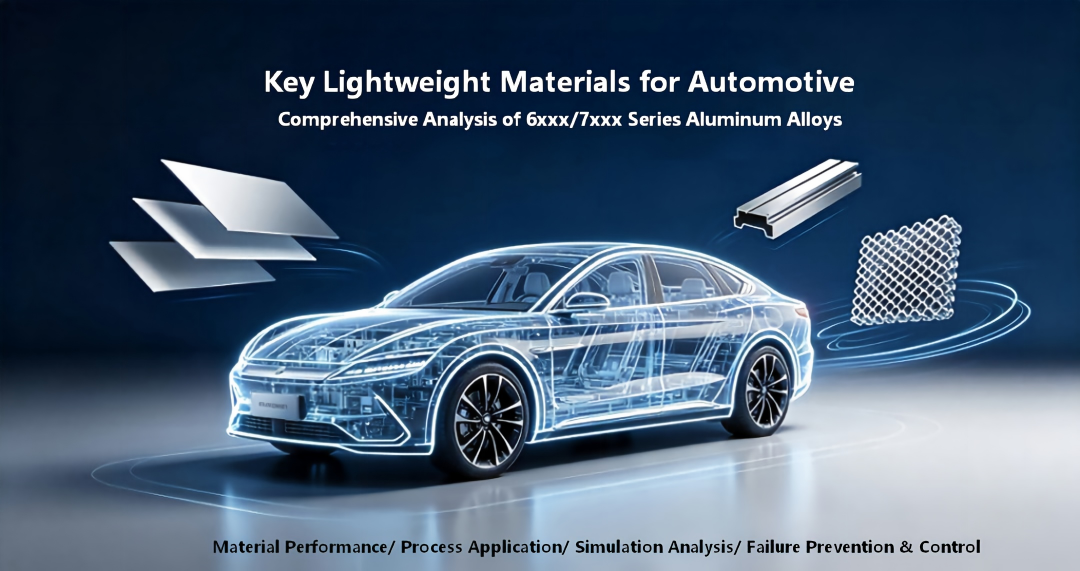
In the current era where automotive electrification and lightweighting are deeply integrated, "reducing weight means increasing range, and improving efficiency means reducing costs" has become an industry consensus. Aluminum alloys, with a density approximately one-third that of steel, a mature processing system, and controllable overall costs, are currently the largest-scale and most widely applicable lightweight metal materials for automotive lightweighting. Among them, the 6xxx series (Al-Mg-Si) and 7xxx series (Al-Zn-Mg) two alloy systems, with their balanced forming corrosion resistance and extremely high specific strength, cover almost all core lightweighting scenarios from body outer covering parts, structural profiles to crash safety components.
This article systematically reviews the brand names, physical and mechanical properties, preparation and processing techniques, vehicle application scenarios, CAE simulation implementation methods of the mainstream 6-series and 7-series aluminum alloys in the automotive field, as well as typical failure issues and solutions during production and service processes. All performance parameters are based on EN standards, official materials handbooks of leading aluminum enterprises, and public academic literature. It can be referred to by practitioners involved in body development, material selection, process engineering, and simulation analysis.
一、6xxx Series Aluminum Alloy (Al-Mg-Si Series)
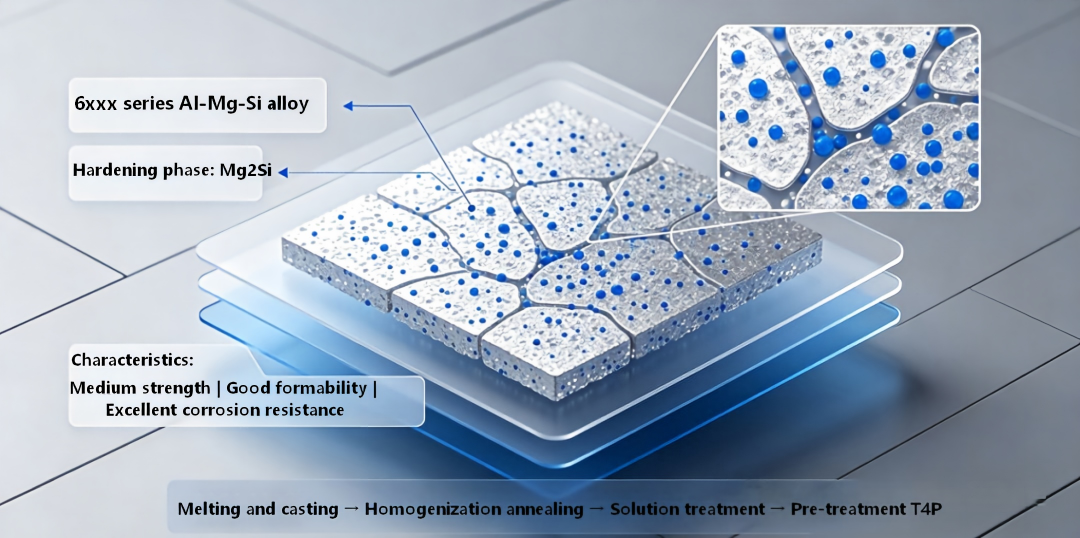
The 6xxx series aluminum alloy is mainly composed of magnesium and silicon as alloying elements, with Mg₂Si as the strengthening phase. It is a heat-treatable strengthened alloy, featuring medium strength, excellent formability, corrosion resistance, and weldability. It is currently the
mainstream material for automotive body panels, structural components, and extruded profiles.
1. Nomenclature System and Conceptual Explanation
Customized 6-series aluminum alloy for the automotive field, the suffix meanings and positioning are as follows:
|
Suffix identifier |
Suffix identification |
Core positioning |
|
T4P |
Pre-aging T4 state (Pre-aged T4) |
After solution quenching and low-temperature pre-treatment, the natural aging process is stabilized, and the curing response of the paint is enhanced. This is the mainstream supply state for automotive stamping plates. |
|
Baking |
Paint hardening state |
Corresponding to the performance after the 170-200℃ electrophoretic baking process of automobiles, the Mg₂Si phase is fully precipitated, and the strength is significantly improved. |
|
IH |
Improved hardening type (Improved Hardening) |
Optimizing the composition and pre-treatment process leads to a higher increase in paint strength and better anti-denting performance. |
|
HS |
High strength type (High Strength) |
Increasing the proportion of alloy elements results in higher strength of both the base material and the baked material, which is suitable for high-load structural components. |
|
IBR |
Improved bendability type |
Optimizing the grains and precipitated phases leads to higher forming limits for bending and flanging, and is suitable for complex cold processing. |
|
E170/E200 |
170℃/200℃ baking performance grade |
Corresponding to the performance indicators after baking for different automakers' coating processes. |
|
S600 |
High strength grade identification |
The strength grade code for high-strength extruded profiles |
|
6K21 |
Component improved type 6 series alloy |
Adjusting the Mg/Si ratio and trace elements, taking into account both forming properties and collision energy absorption |
|
HAZ 0.7/0.63/0.43 |
Welding heat affected zone strength reduction coefficient |
The ratio of the yield strength of the heat-affected zone after welding to the base material is a core parameter for welding structure design |
|
AC118/AC170/AC600 |
Artificial aging process code |
Corresponding to different temperature/length aging heat treatment systems |
|
F22 |
Extrusion online quenching process |
Direct online quenching after extrusion, followed by manual aging to achieve T6 performance |
|
OUTER BONNET LOW/HIGH |
Exterior panel of engine cover special grade |
LOW represents high formability and low strength version, while HIGH represents high anti-denting and high strength version |
|
SAPA LOWER |
SAPA brand low strength grade |
Specific performance range products of Norsk Hydro's SAPA extruded materials |
2. Core Physical Chemistry and Mechanical Properties
(1) Basic Physical and Chemical Characteristics
• Density: All range from 2.69 to 2.72 g/cm³, approximately one-third of that of steel, resulting in significant lightweighting effect
• Elastic modulus: Approximately 70 GPa, one-third of that of steel
• Thermal conductivity: Approximately 180-200 W/(m・K), three-fourths of that of steel
• Linear expansion coefficient: Approximately 23×10⁻⁶ /℃, twice that of steel
• Corrosion resistance: Under natural conditions, a dense oxide film forms on the surface, exhibiting excellent corrosion resistance in atmospheric environment; the 6 series has a low copper content and no obvious tendency for stress corrosion, and has good stability in weak acid and alkali environments
(2) Typical Mechanical Properties and Yield-Strength Ratio (Typical values at room temperature)
Sheet-like (Automobile body panels)
|
Alloy Grade & Temper |
Tensile Strength Rm (MPa) |
0.2% Offset Proof Strength Rp0.2 (MPa) |
Elongation after Fracture A (%) |
Yield-to-Tensile Strength Ratio Rp0.2/Rm |
Remarks |
|
6016-T4P |
190~230 |
90~120 |
24~28 |
0.47~0.52 |
Supply state, excellent formability |
|
6016-T4P+Baking |
260~300 |
170~210 |
18~22 |
0.65~0.70 |
After baking at 180℃ for 20 minutes |
|
6014-T4P |
200~240 |
100~130 |
22~26 |
0.50~0.54 |
Surface quality is excellent, suitable for external covering parts |
|
6111-T4 |
220~260 |
120~150 |
20~24 |
0.55~0.58 |
Strong baking hardening effect |
|
6451-T4P |
240~280 |
130~160 |
20~23 |
0.54~0.57 |
Special for structural components, good energy absorption during collision |
Profile type (extruded structural components)
|
Alloy Grade & Temper |
Tensile Strength Rm (MPa) |
0.2% Offset Proof Strength Rp0.2 (MPa) |
Elongation after Fracture A (%) |
Yield-to-Tensile Strength Ratio Rp0.2/Rm |
HAZ reduction factor |
|
6005A-T6 |
260~300 |
210~250 |
12~16 |
0.80~0.83 |
~0.6 |
|
6060-T6 |
290~320 |
240~270 |
10~14 |
0.82~0.84 |
~0.58 |
|
6061-T6 |
280~320 |
240~280 |
10~14 |
0.85~0.88 |
0.5(National standard value) |
|
6063-T6 |
200~240 |
170~200 |
10~14 |
0.83~0.85 |
0.5(National standard value) |
|
6082-T6 |
300~340 |
260~290 |
8~12 |
0.85~0.87 |
~0.55 |
3. Typical Preparation and Processing Procedures
(1) Automotive Sheet Metal Production Process
1. Melting and Casting: Precisely control the Mg/Si ratio (typically 1.0 - 1.3), add Mn, Cr, etc. as trace elements to refine the grains, and conduct semi-continuous casting to produce large-sized ingots
2. Homogenization Annealing: Hold at 550/570°C for 6/10 hours to eliminate casting stresses and ensure uniform dissolution of precipitated phases
3. Hot Rolling + Cold Rolling: Initial rolling temperature at 540/560°C, hot rolling to 5/7 mm, then cold rolling to the target thickness (typically 0.8 - 2.0 mm)
4. Solution Annealing: Continuous solution in an air bath furnace (holding at 540/580°C for 0.5/3 minutes), water cooling at a rate > 50°C/s, obtaining supersaturated solid solution
5. Pre-Treatment: After quenching, quickly enter a low-temperature furnace (80 - 120°C) for holding, slow cooling to stabilize the microstructure, achieving T4P state
6. Finishing and Oil Coating: Straightening the plate shape, surface passivation, coating with stamping lubricating oil, and delivering to the main manufacturer
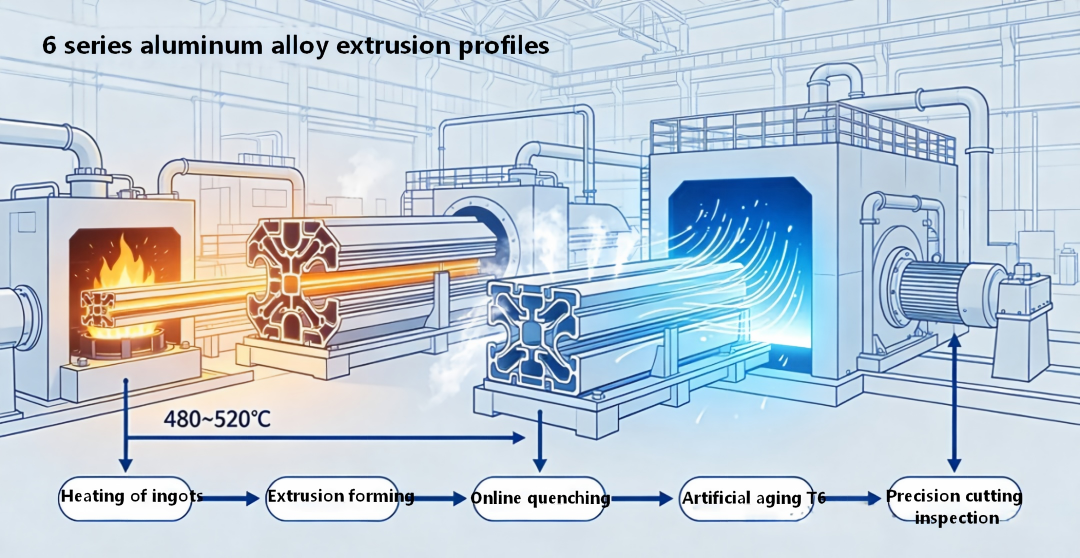
(2) Extrusion Profile Production Process
1. After homogenization of the ingot, heat to 480 - 520°C, and extrude the target cross-section using an extrusion machine
2. Direct online quenching at the extrusion outlet (air-cooled or water mist-cooled), obtaining the solution state microstructure
3. Artificial Aging Treatment (holding at 170/180°C for 4/8 hours), reaching the peak strength of T6
4. Subsequent precision cutting, surface treatment (anodizing, spraying, etc.)
4. Industrial and Automotive Vehicle Applications
(1) General Industrial Applications
Railway car bodies, building facades, photovoltaic supports, electronic equipment structural components, construction machinery parts, etc.
(2) Automotive Vehicle Segment Applications
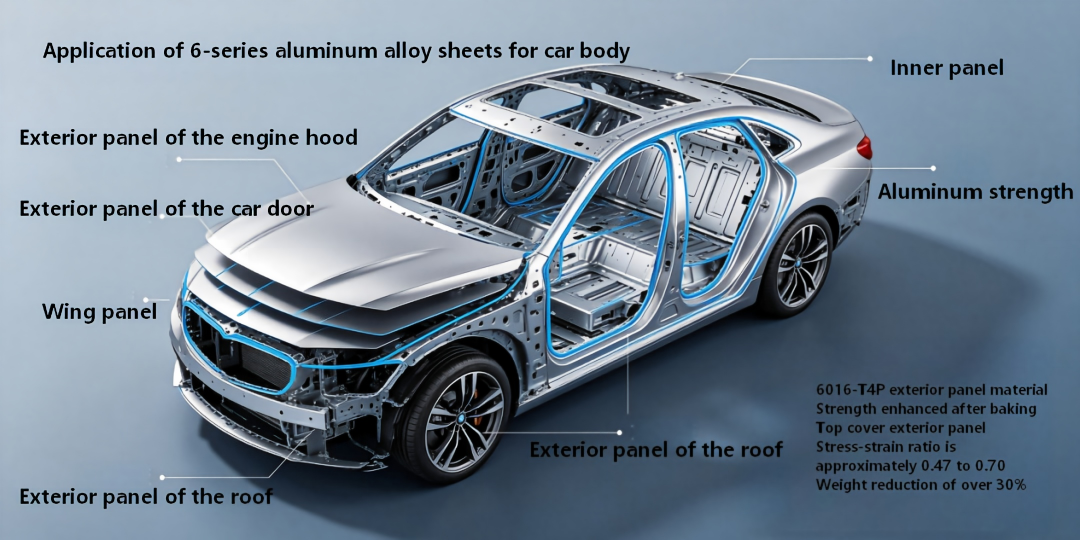
Body panels (outer panels): 6016, 6014, 6111 are the core materials selected
• Outer panels of the hood, outer panels of the doors, fenders, outer panels of the roof
• Advantages: T4P easy stamping forming, increased strength after painting, meeting the requirements for external panel impact resistance, weight reduction by over 30% for body structural components (inner panels / beam systems): 6451, 6082, 6005A are the main materials
Door inner panels, engine hood inner panels, longitudinal beams, threshold beams, floor crossbeams, seat frames
•Advantages: Balance of strength and energy absorption, can be formed by stamping or extrusion, suitable for collision force transmission paths of chassis and accessories: 6082, 6061, 6063
•Impact beam, sub-frame, control arm, wheel hub, luggage rack, chassis guard plate
•Advantages: Medium strength to meet load-bearing requirements, corrosion resistance suitable for complex chassis working conditions
5. Expansion of CAE Simulation Applications
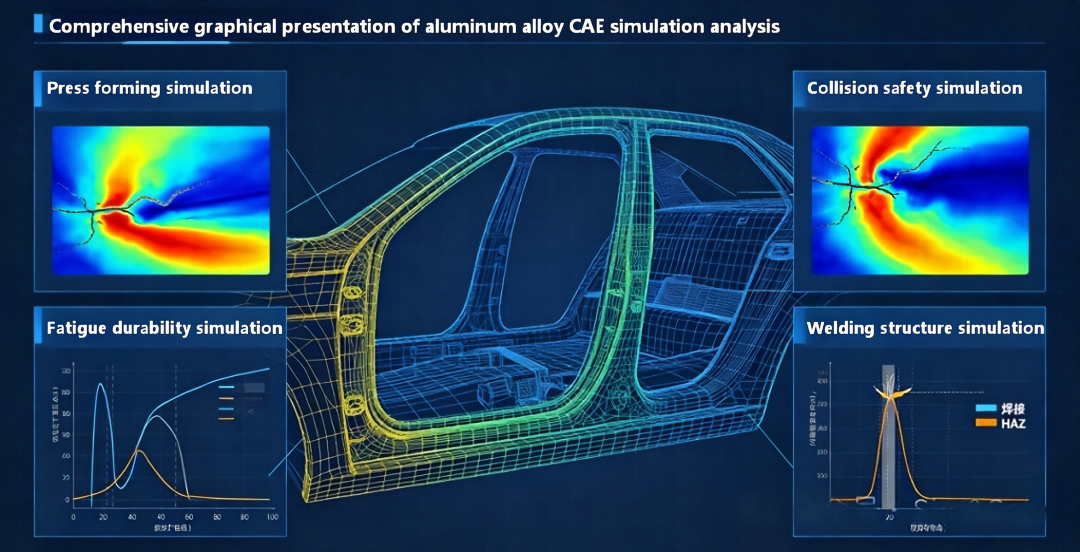
(1) Pressing Forming Simulation
• Tools: AutoForm, Dynaform, Abaqus/Standard
• Core Applications: Predicting forming limits, wrinkling, cracking and springback amounts, optimizing clamping force, layout of stretch ribs and pressing speed
• Key Models: Adopting Barlat anisotropic yield criterion, matching the plane anisotropy of 6 series aluminum plates, improving the accuracy of springback prediction; within the industry, through simulation, the deviation of springback control can be reduced to within 5%
(2) Crash Safety Simulation
• Tools: LS-DYNA, Abaqus/Explicit, Radioss
• Constitutive Model: Mainly adopts Johnson-Cook (JC) constitutive model to describe the flow stress behavior under high strain rates, typical parameters for 6061-T6: A=285MPa, B=245MPa, n=0.28, C=0.028, correlation coefficient R² > 0.96
• Failure Model: Using CrachFEM failure model, can accurately predict the initiation and expansion of fractures under different stress states, supporting component-level and vehicle-level crash fracture simulation
• Engineering Value: Replacing some crash tests, shortening the development cycle, optimizing the energy absorption efficiency of the structure
(3) Fatigue Durability Simulation
• Tools: nCode, Fe-safe, MSC Fatigue
• Method: Based on the material S-N curve (when the stress ratio R=-1 for 6082-T651, the fatigue limit under 10⁷ cycles is approximately 73MPa), combined with stress concentration coefficient, surface roughness, welding HAZ softening and other correction factors, predict the fatigue life of the structure
• Application: Durability verification of chassis components and body frame systems, can identify fatigue weak points in advance
(4) Welding Structure Simulation
• Considering the strength reduction coefficient of HAZ, setting softened material properties around the weld seam
• Simulating welding residual stress and deformation, optimizing welding sequence and process parameters, controlling the dimensional accuracy of the structure
二、7xxx Series Aluminum Alloys (Al-Zn-Mg Series)
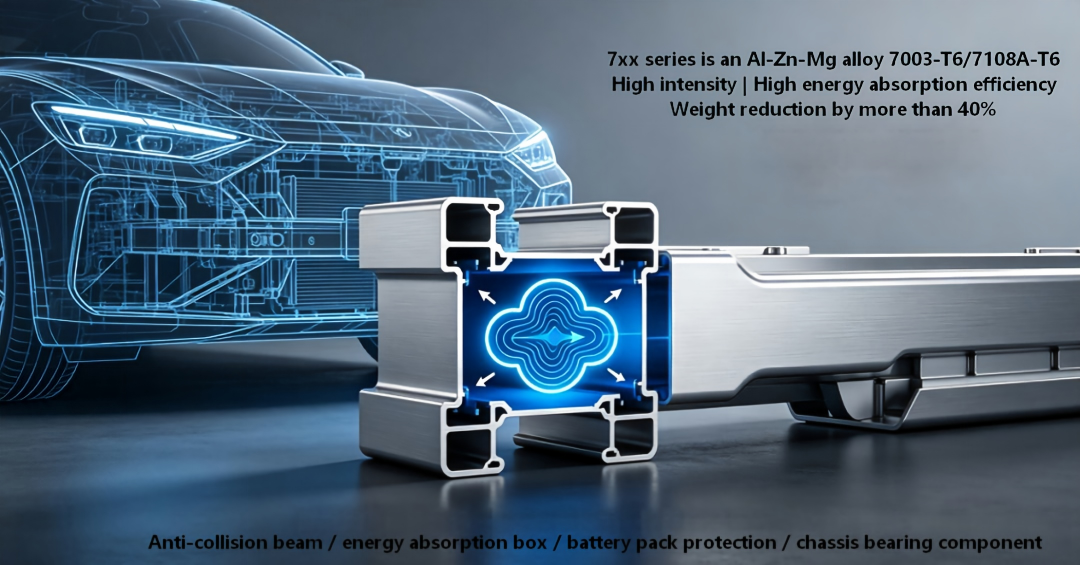
The 7xxx series of aluminum alloys mainly consist of zinc and magnesium as the alloying elements. They achieve aging strengthening through the η-MgZn₂ phase. It is the series with the highest strength. Among them, 7003 and 7108A are medium-strength 7-series alloys specifically for automotive structural components, which balance strength, extrusion properties, and weldability.
1. Brand Number System and Conceptual Analysis
• 7003-T6: An Al-Zn6Mg0.8Zr alloy, with zirconium added to refine grains and enhance crack resistance and fatigue performance. It is the mainstream material choice for automotive crash protection systems.
• 7108A-T6: An improved version of 7003, with better balance of strength and toughness, excellent extrusion performance, and suitable for complex cross-sectional profiles.
• HAZ 0.67/0.47: The range of strength reduction coefficients for the welding heat affected zone, with the maximum value at 0.67 and the minimum at 0.47, corresponding to different welding processes and positions.
2. Core Physical Chemistry and Mechanical Properties
(1) Basic Characteristics
• Density: 2.78 - 2.82 g/cm³, slightly higher than 6 series, still much lower than steel.
• Strength: Significantly higher than 6 series, with a comparable specific strength to high-strength steel.
• Corrosion Resistance: Overall corrosion resistance is weaker than 6 series, with certain stress corrosion cracking (SCC) sensitivity, more obvious in T6 state, and can be improved with two-stage aging T7 state.
• Weldability: 7003/7108A belong to weldable 7 series alloys. Their weldability is better than 7075 ultra-hard aluminum, but still have the problem of HAZ softening.
(2) Typical Mechanical Properties and Yield Strength Ratio (T6 state extruded profiles)
|
Material grade status |
Tensile Strength Rm (MPa) |
Yield strength Rp0.2 (MPa) |
Elongation after Fracture A (%) |
Yield-to-Tensile Strength Ratio Rp0.2/Rm |
HAZ reduction coefficient range |
|
7003-T6 |
340~380 |
280~310 |
10~13 |
0.82~0.84 |
0.47~0.67 |
|
7108A-T6 |
350~390 |
290~320 |
9~12 |
0.83~0.85 |
0.47~0.67 |
3. Typical Preparation and Processing Procedures
1. Melting and Casting: Strictly control the contents of Zn and Mg, add Zr and Ti to refine the grains, and control the contents of Fe and Si impurities
2. Homogenization Treatment: Long-term heating at 460-480°C to eliminate casting segregation
3. Extrusion Forming: Extrusion at 420-480°C, online quenching at the exit
4. Heat Treatment: Standard T6 is 120°C/24 hours for single-stage aging; for scenarios requiring anti-corrosion performance, use double-stage aging (T74), sacrificing 10-15% strength in exchange for stress corrosion resistance
5. Subsequent Processing: CNC milling, bending, surface spraying, etc.
4. Industrial and Automotive Vehicle Applications
(1) General Industrial Applications
Railway structural components, aerospace secondary load-bearing components, lifting equipment, high-pressure vessels, sports equipment, etc.
(2) Automotive Vehicle Sub-Applications
Collision safety system: Core application scenarios of 7003/7108A
• Front and rear impact beams, energy absorption boxes, bumper reinforcement parts
• Advantages: High strength + high energy absorption efficiency, the I-shaped section profiles have a weight reduction of more than 40% compared to steel impact beams, and the collision energy absorption capacity is increased by 30%
Vehicle frame structure components
• Threshold beam, A/B beam reinforcements, front longitudinal beam, battery pack frame
• Advantages: High specific strength, achieving higher load-bearing capacity within a limited cross-sectional space, suitable for the chassis load-bearing components that meet the protection requirements of new energy vehicle battery packs
• Sub-frame, control arm, steering knuckle
• Advantages: Reducing the unsprung mass, improving vehicle handling performance and range performance
5. Expansion of CAE Simulation Applications
The differences between 7-series aluminum alloy simulation and 6-series core lie in:
1. Crash simulation: The sensitivity to strain rate is higher, and the nonlinearity during the high-temperature softening stage is more significant. The traditional JC model deviates by up to 18% above 400℃, and the Zerilli-Armstrong constitutive model needs to be introduced for supplementary correction.
2. Fatigue simulation: Additional consideration must be given to the stress corrosion coupling effect. In a corrosive environment, the fatigue life reduction coefficient needs to be set at 0.6 to 0.8.
3. Welding simulation: The HAZ (Heat Affected Zone) softening range is wider, and the strength fluctuation is greater. The limit condition verification needs to be conducted separately at the maximum and minimum values.
4. Extrusion forming simulation: HyperXtrude and other software are used to simulate metal flow, temperature field and microstructure evolution. The extrusion speed and mold design are optimized to avoid cracking and coarse grain ring defects.
三、Common Problems and Solutions in Aluminum Alloy Production and Service
1. Material Fatigue Failure
Problem Description: Under repeated alternating loads, fatigue cracks start to form at stress concentration points in the material and continue to expand, eventually resulting in low-stress brittle fracture, which is one of the main failure modes for automotive chassis and body frame systems. The fatigue life of aluminum alloy spot weld joints is only 20% to 30% of that of steel joints of the same thickness, making them a weak link.
Causes:
• Structures have stress concentration features such as holes, notches, and corners
• Welding joints have pores, inclusions, HAZ softening and residual stress
• Defects such as surface scratches and corrosion pits become sources for crack initiation
• The amplitude of alternating loads exceeds the material's fatigue limit Solution:
• Design side: Optimize the radius of the structural corners to avoid sharp corners and abrupt changes in cross-section, thereby reducing the stress concentration coefficient.
• Process side: Preferentially adopt mechanical connections such as self-tapping riveting (SPR) and flow-drilling screws (FDS) instead of spot welding to enhance the fatigue performance of the joints; after welding, perform grinding and shot blasting, and introduce residual compressive stress.
• Material side: Select fine-grained, high-purity alloys, control the size and distribution of inclusions; adopt a two-stage aging process to enhance fatigue resistance
• Simulation side: Conduct fatigue life verification based on the Miner linear cumulative damage law, and reserve a safety factor
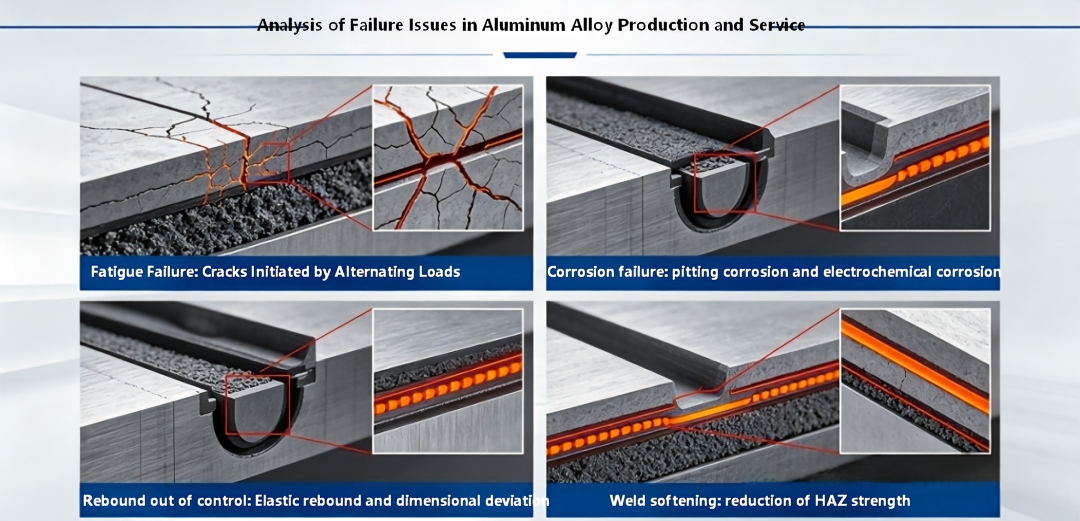
2. Material Corrosion Failure
Problem Description: Materials undergo chemical or electrochemical reactions in environmental media, resulting in surface deterioration, performance decline, and even structural failure. Common corrosion types of aluminum alloys include pitting corrosion, intergranular corrosion, stress corrosion cracking (SCC), and galvanic corrosion.
Causes:
• Pitting Corrosion: Chloride ion environment (coastal, deicing salt) damages the surface oxide film, forming localized corrosion pits
• Stress Corrosion: 7-series high-strength aluminum, under the combined action of tensile stress and corrosive medium, undergoes intergranular cracking
• Galvanic Corrosion: When aluminum alloy comes into contact with metals with more positive potentials such as steel or copper, an electrolytic cell forms in a humid environment, with aluminum acting as the anode and accelerating corrosion
Solutions:
• Surface Protection: Use anodizing, electrophoretic coating, powder spraying, etc. to form a protective layer; apply anti-corrosion wax to key parts
• Structural Design: Avoid water accumulation structures, set drainage holes; add insulating pads when connecting different metals to isolate electrical contact
• Material Selection: Select 6-series for outer covering parts with high corrosion resistance; replace T6 state of 7-series structural parts with T7 state to enhance SCC resistance
• Electrochemical Protection: Install sacrificial anodes (zinc blocks) inside closed cavities
3. Uncontrolled Plastic Deformation and Springback
Problem Description: After stamping, the part undergoes springback, and the dimensional accuracy fails to meet the assembly requirements; during service, under load, it experiences plastic deformation, affecting the structural stability. The elastic modulus of aluminum alloy is low, and the springback amount is 2 to 3 times that of steel. It is a core difficulty in the stamping process.
Causes:
• Low elastic modulus, resulting in a large elastic recovery after plastic deformation
• Fluctuations in material yield strength and anisotropy causing uneven springback
• Insufficient structural stiffness, with the service load exceeding the yield strength
Solutions:
• Stamping Process: Use forming simulation to predict the springback amount, and design compensation for the mold surface; adopt stretch forming instead of simple bending to increase the proportion of plastic deformation
• Process Supplements: Set up a finishing process to perform secondary fine pressing on key dimensions
• Structural Optimization: Add ribs and flanges to increase the section inertia moment, enhancing the structural stiffness
• Quality Control: Strictly control the fluctuation range of the yield strength of the sheet material when supplied, and shorten the natural aging storage period
4. Forming and Service Crack
Problem Description: During the stamping process, the sheet material cracks (such as stretch cracking, bending cracking); during service, the structure develops cracks and expands, resulting in structural failure.
Causes:
• Insufficient sheet elongation, deformation exceeding the forming limit
• T4P state sheet materials stored for too long, natural aging leads to an increase in yield strength and a decrease in plasticity
• Insufficient stamping lubrication, small mold fillets, local strain concentration
• During service, the impact load exceeds the material's fracture toughness, or fatigue cracks extend to the critical size
Solutions:
• Material side: Select IBR and other high forming performance grades; strictly implement the aging management requirements within 6 months, and revalidate the performance of materials that have exceeded the time limit
• Process side: Optimize stamping parameters, use dedicated aluminum alloy stamping oil; increase mold fillets, optimize the layout of stretch ribs; for complex parts, adopt warm stamping process, heating to 200-300°C can increase the forming limit by 30%-50%
• Design side: Avoid local severe deformation, evenly distribute the deformation; conduct fracture toughness verification for key load-bearing parts
• Inspection side: Use non-destructive testing methods such as eddy current and ultrasonic to detect internal defects and micro-cracks
5. Softening of the heat-affected zone and hot cracks
Problem description: After fusion welding, the age-hardening phases in the heat-affected zone around the weld seam dissolve or coarsen, resulting in a significant decrease in strength (the strength of 6 series T6 state HAZ is reduced by approximately 40-50%, and 7 series can reach over 50%); high alloying 7 series is prone to welding hot cracks.
Causes:
• The welding heat cycle causes the HAZ temperature to exceed the aging temperature, resulting in over-aging or re-dissolution of the strengthening phases
• The wide alloy solidification temperature range forms low-melting-point eutectic phases at the grain boundaries, and during cooling contraction, crystallization cracks are generated
• Excessive welding heat input increases the HAZ width, leading to more severe softening
Solutions:
• Process selection: Preferentially adopt friction stir welding (FSW) instead of fusion welding to significantly reduce the degree of HAZ softening; for fusion welding, adopt a small heat input process (CMT cold metal transition welding)
• Material selection: During the design of the welding structure, reserve a HAZ strength reduction coefficient, increase the cross-sectional thickness, or select a higher strength base material
• Post-welding treatment: For some alloys, part of the HAZ strength can be partially restored through post-welding artificial aging
• Crack prevention: Optimize welding parameters, use appropriate filler wires; design reasonable bevels and assembly clearances to reduce welding stress
Conclusion
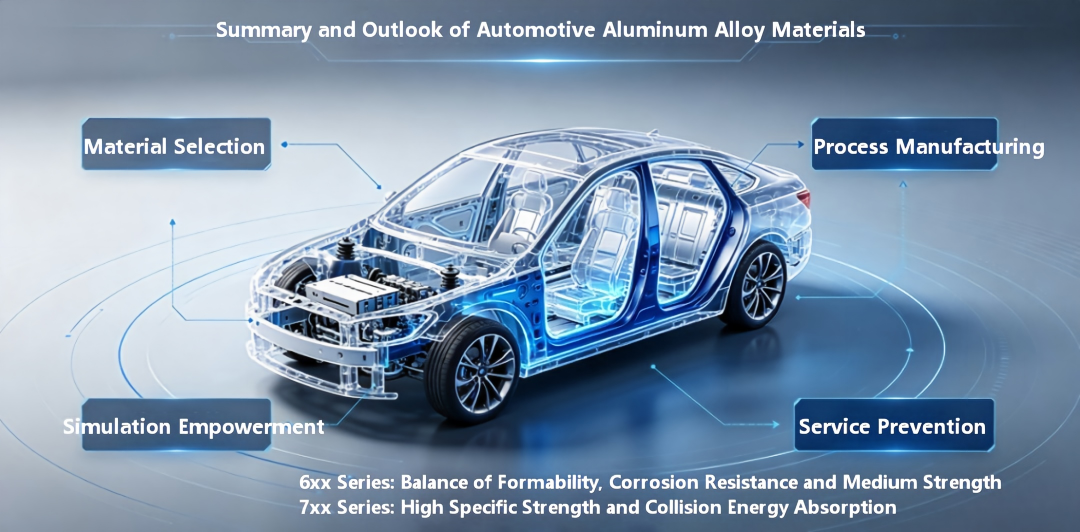
The 6xxx series and 7xxx series of aluminum alloys together form the "foundation base" and "high-strength lines" of aluminum lightweighting in automobiles: the former, with its "soft forming and hard service" baked hardening characteristic and balanced corrosion resistance and welding performance, has become the common preferred choice for body panels and mid-load structures; the latter, with higher specific strength and collision energy absorption efficiency, assumes the core functions of safety components and high-load frames. These two are not in a substitution relationship; instead, they form the optimal performance, process and cost matching in different parts of the entire vehicle.
With the continuous upgrading of lightweight requirements for new energy vehicles, the aluminum material system is still undergoing continuous iterations - new generations of 6-series plates with higher baking hardening response, 7-series extruded materials with high corrosion resistance and toughness, and new categories such as non-heat-treated die-casting aluminum alloys have been continuously launched; at the same time, the progress of high-precision material constitutive models and multi-field coupling simulation technologies is also continuously shortening the time from laboratory to production vehicle. The synergy of material innovation, process breakthroughs and simulation empowerment will continue to drive the evolution of automotive lightweighting towards more efficient, safer and lower-cost directions.


