


In the triangular competition of lightweighting, high safety and low cost in the automotive industry, advanced high-strength steel has always been the absolute core of the body-in-white material system. From the easily formable outer covering parts to the anti-collision safety structural components, from cold-formed low-carbon steel to 1800MPa grade hot-formed boron steel, the microstructure characteristics, mechanical performance, process windows and applicable scenarios of different steel types vary greatly, directly determining the cost, weight and safety performance of the vehicle body.
For professionals involved in vehicle body design, CAE simulation, material selection and process development, establishing a complete, accurate and practical knowledge system for high-strength steel is the foundation for solving on-site problems such as forming cracks, excessive rebound, and fatigue failure. This article systematically reviews the 7 major types of mainstream automotive steel grades under the VDA standard system. It covers the material's essential properties, core mechanical parameters, production process logic, as well as the application scenarios of the entire vehicle, CAE simulation direction, and solutions to all failure issues throughout the process. All performance data are derived from the public specifications of steel mills and industry standards.
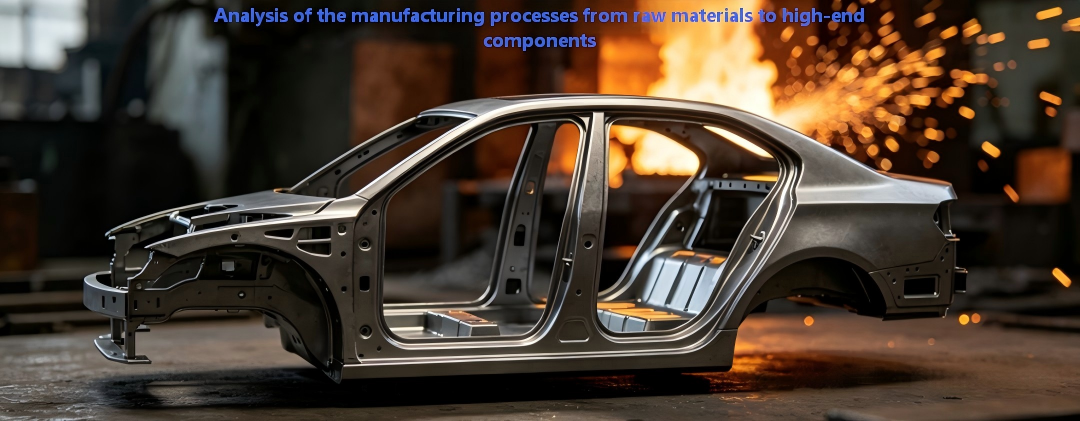
一、Cold Rolled High-Strength Interstitial-Free (IF) Steels
1. Material Concept and Microstructural Properties
IF steel, short for Interstitial-Free Steel, uses microalloying elements such as titanium (Ti) and niobium (Nb) to fully immobilize interstitial carbon (C) and nitrogen (N) atoms in the form of carbonitrides. Its matrix consists of pure ferrite. Characterized by an extremely low yield point and superior deep drawability (high r-value and high n-value), IF steel serves as the fundamental material for automotive outer panels and complex deep-drawn components.
High-strength IF steels retain excellent formability while boosting strength via solid-solution strengthening and grain refinement strengthening, striking a balance between lightweight design and forming requirements.
2. Key Mechanical Properties and Yield-to-Tensile Ratio
(Data source: VDA 239-100 standard, product specifications of Salzgitter and Baoshan Iron & Steel)
|
Grade |
Yield Strength ReL / Rp0.2 (MPa) |
Tensile Strength Rm (MPa) |
Elongation after Fracture A80 (%) |
Typical Yield-to-Tensile Ratio |
Core Characteristics |
|
CR180IF |
180 ~ 240 |
320 ~ 400 |
≥ 35 |
~ 0.56 |
Optimum deep drawability, comparable to conventional deep drawing steel |
|
CR210IF |
210 ~ 270 |
340 ~ 420 |
≥ 33 |
~ 0.62 |
Balanced formability and strength |
|
CR240IF |
240 ~ 300 |
360 ~ 440 |
≥ 31 |
~ 0.67 |
Medium-high strength deep drawing steel |
|
CR260IF |
260 ~ 320 |
380 ~ 440 |
≥ 30 |
~ 0.68 |
Top grade of high-strength IF steel with excellent dent resistance |
3. Key points of production process
• Smelting end: Ultra-low carbon control (C ≤ 0.01%), adding Ti/Nb to fix interstitial atoms, and strictly controlling impurity elements such as S and P.
• Rolling end: The cold rolling reduction rate is controlled at 70%-80%, combined with the continuous annealing recrystallization process, to ensure uniform grain structure and high plastic strain ratio.
• Post-processing: It can be coated with hot-dip galvanizing or electro-galvanizing layers to meet the requirements for corrosion prevention.
4. Application in Complete Vehicles
• Outer body panels: Outer panels of the engine hood, outer panels of the luggage compartment, outer panels of the car doors, and fenders, taking into account both complex shape stamping and the quality of the exterior surfaces.
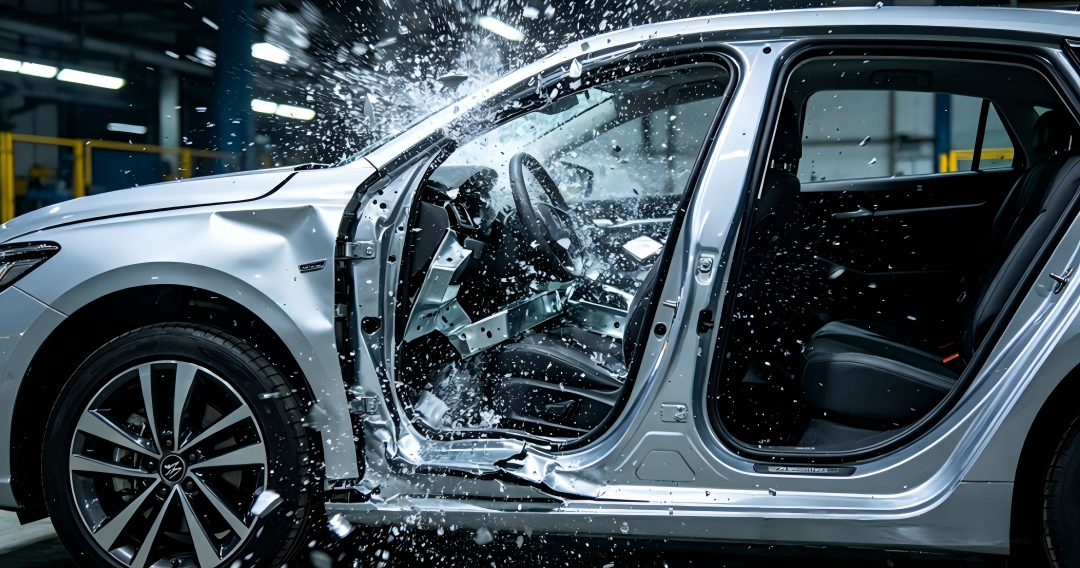
5. Simulation Application Direction
• Press forming simulation: Using AutoForm and Dynaform, the wrinkling, cracking and thinning rate of the deep drawing process are simulated to optimize the die blank size and the layout of the drawbar.
• Anti-denting simulation: Based on stiffness analysis, the deformation amount of the outer panel under local loads is evaluated, and the material strength and plate thickness design are matched.
二、 Cold Rolled Bake-Hardenable (BH) Steels
1. Material Concept and Microstructural Properties
BH steel, the abbreviation for Bake-Hardenable Steel, features a ferrite matrix. By regulating the content of solute carbon atoms, it achieves the distinctive property of low yield strength for easy forming during stamping and enhanced strength after paint baking.
Dislocations multiply throughout the stamping process. In the subsequent automotive coating baking procedure (170°C for 20 minutes), interstitial carbon atoms precipitate and pin dislocations. This mechanism raises the yield strength by 30–50 MPa and greatly improves the dent resistance of finished parts.
2. Key Mechanical Properties and Yield-to-Tensile Ratio
(Data source: VDA 239-100 standard, product specifications of thyssenkrupp)
|
Grade |
Yield Strength As-Delivered (MPa) |
Tensile Strength As-Delivered (MPa) |
Yield Strength Increment After Baking (MPa) |
Elongation after Fracture A80 (%) |
Typical Yield-to-Tensile Ratio (As-Delivered) |
|
CR180BH |
180 ~ 230 |
290 ~ 360 |
≥ 30 |
≥ 34 |
~ 0.62 |
|
CR210BH |
210 ~ 260 |
320 ~ 390 |
≥ 30 |
≥ 32 |
~ 0.66 |
|
CR240BH |
240 ~ 300 |
340 ~ 440 |
≥ 35 |
≥ 29 |
~ 0.71 |
|
CR300BH |
300 ~ 360 |
400 ~ 480 |
≥ 40 |
≥ 26 |
~ 0.75 |
3. Key points of production process
• Component Control: Precisely control the solute carbon content, balance the baking hardening value with the room temperature anti-ageing property, and prevent natural ageing during storage.
• Annealing process: Continuous annealing with rapid cooling, solubilizing oversaturated carbon atoms, ensuring the BH responsiveness of the finished product.
4. Application in Complete Vehicles
• The core application is for automotive exterior components: doors, hood, fenders, and trunk lid. This is a mainstream solution that takes into account both the appearance shaping and the usage strength, and can achieve a lightweight effect by reducing the plate thickness by 0.1-0.2mm.
Medium-high strength BH steel is also used for secondary structural components such as the inner panels of the threshold and the floor beams.
5. Simulation Application Direction
• Forming simulation: Incorporation of a baking hardening constitutive model to distinguish the differences in mechanical properties between the formed shape and the one after baking.
• Stiffness and anti-deformation simulation: Simulate the stiffness of the finished product after coating, and verify the anti-deformation and anti-stone-impact performance of the outer panel.
三、 Cold Rolled Dual Phase (DP) Steels
1. Material Concept and Microstructural Characteristics
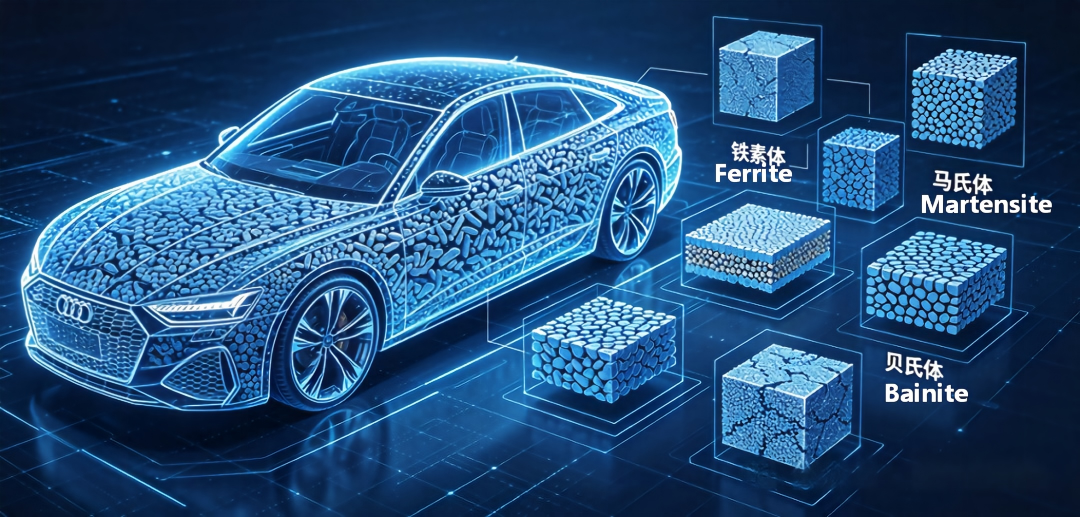
DP steel (Dual Phase Steel) is the core grade of the first-generation Advanced High-Strength Steel (AHSS). Its microstructure consists of a soft ferrite matrix with dispersed hard martensite islands. The volume fraction of martensite increases from 5% to over 40% with ascending strength grades.
Its key advantages include a low yield-to-tensile ratio, high work-hardening index, absence of yield plateau and superior crash energy absorption efficiency, making it the most widely used steel grade for automotive structural safety components.
2. Key Mechanical Properties and Yield-to-Tensile Ratio
(Data source: Baosteel Standard Q/BQB 418-2023, ASTM A1088 specification)
|
Grade |
Yield Strength (MPa) |
Tensile Strength (MPa) |
Elongation after Fracture A80 (%) |
Typical Yield-to-Tensile Ratio |
Strength Classification |
|
CR250Y440T-DP |
250 ~ 320 |
≥ 440 |
≥ 27 |
~ 0.57 |
Low-strength grade DP steel |
|
CR290Y490T-DP |
290 ~ 380 |
≥ 490 |
≥ 23 |
~ 0.59 |
Medium-low strength grade |
|
CR330Y590T-DP |
330 ~ 440 |
≥ 590 |
≥ 20 |
~ 0.56 |
Main structural grade |
|
CR440Y780T-DP |
440 ~ 550 |
≥ 780 |
≥ 14 |
~ 0.56 |
High-strength safety grade |
|
CR590Y980T-DP |
590 ~ 700 |
≥ 980 |
≥ 10 |
~ 0.60 |
Ultra-high strength structural grade |
|
CR900Y1180T-DP |
900 ~ 1050 |
≥ 1180 |
≥ 8 |
~ 0.76 |
Extra-high strength cold-formable steel |
|
CR1150Y1400T-DP |
1150 ~ 1300 |
≥ 1400 |
≥ 6 |
~ 0.82 |
Upper strength limit for cold forming |
√Rule: Low-strength DP steels feature a low yield-to-tensile ratio and excellent energy absorption capacity. As the strength grade rises, the martensite volume fraction increases, and the yield-to-tensile ratio climbs gradually.
3. Key Production Process Points
• Core process: Cold rolling + intercritical heating during continuous annealing + rapid cooling. The steel sheet is heated to the ferrite-austenite two-phase region, held at temperature and then rapidly cooled, whereby austenite transforms into martensite.
• Process challenges: Precisely control cooling rate and coiling temperature to ensure uniform martensite content and morphology. For hot-dip galvanized DP steel, the galvanizing temperature must be coordinated with phase transformation processes.
4. Application in Complete Vehicles
• 440-590 MPa grade: Front and rear longitudinal beams, floor crossbeams, seat frames, and threshold reinforcement plates, balancing formability and structural strength.
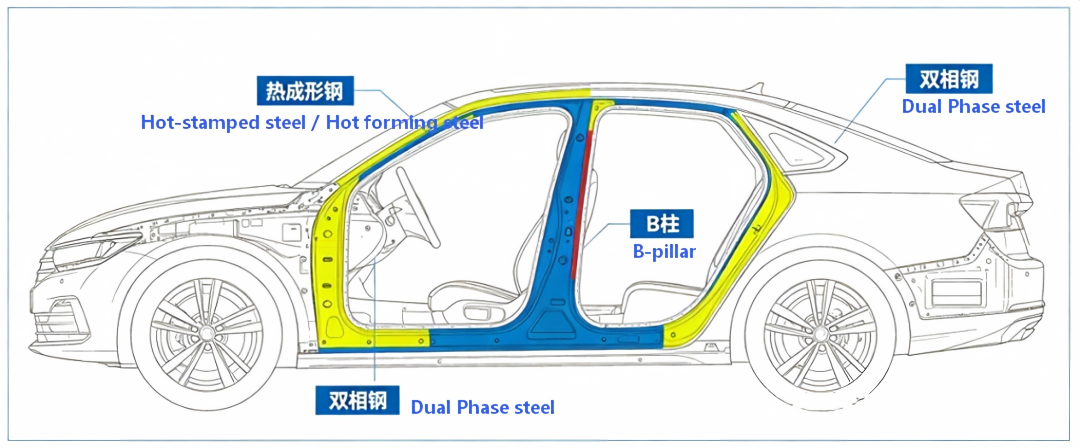
• 780-980 MPa grade: The B-pillar reinforcement plate, side door impact beam, front impact beam, and energy absorption box are the core materials for collision safety.
• Above 1180 MPa grade: Rear bumper reinforcement parts, inner panel of the门槛, replace some heat-formed parts with cold stamping to achieve cost reduction.
5. Simulation Application Direction
• Collision simulation: In LS-DYNA/RADIOSS, the MAT_24 (piecewise linear elastoplastic) model combined with the Cowper-Symonds strain rate model is commonly used to accurately simulate the stress-strain evolution and energy absorption during high-speed collisions.
• Forming simulation: Focus on predicting the rebound and cracking risks of high-strength steel, and guide the compensation for forming deformation; Introduce the forming limit diagram (FLD) to determine the forming window.
四、Cold Rolled TRIP Steels
1. Material Concept and Microstructural Properties
TRIP steel stands for Transformation Induced Plasticity Steel. Its microstructure consists of ferrite, bainite and 5%–15% retained austenite.
During plastic deformation, metastable retained austenite gradually transforms into martensite, generating continuous work hardening and delaying necking. Consequently, its product of strength and elongation (tensile strength × elongation) is remarkably higher than DP steel of identical strength grade, delivering superior formability.
2. Key Mechanical Properties and Yield-to-Tensile Ratio
(Data source: Baosteel product specifications, ASTM A1088 standard)
|
Grade |
Yield Strength (MPa) |
Tensile Strength (MPa) |
Elongation after Fracture A80 (%) |
Typical Yield-to-Tensile Ratio |
Core Advantages |
|
CR400Y690T-TR |
400 ~ 510 |
≥ 690 |
≥ 24 |
~ 0.58 |
High elongation, suitable for complex forming |
|
CR450Y780T-TR |
450 ~ 560 |
≥ 780 |
≥ 22 |
~ 0.58 |
High product of strength and elongation, sustainable crash energy absorption |
3. Key Production Process Points
• Alloy design: High Mn together with Si/Al composite alloying to stabilize retained austenite and suppress carbide precipitation during bainite transformation.
• Annealing process: Intercritical annealing plus isothermal bainite transformation, enabling carbon enrichment in retained austenite to secure austenite stability at room temperature.
4. Automotive Vehicle Applications
• Complex-shaped structural safety components: Upper B-pillar, deformable section of front side member, wheel house reinforcement, rear axle mounting bracket and other parts requiring heavy-stroke stamping.
• Crash energy-absorbing zone components: Rely on continuous work hardening brought by the TRIP effect to realize progressive deformation and energy absorption during collision, so as to improve occupant protection performance.
5. CAE Simulation Application Directions
• Forming simulation: The TRIP phase transformation constitutive model shall be adopted to account for hardening evolution induced by retained austenite transformation during deformation, so as to accurately predict the forming limit.
• Crash simulation: User-defined material subroutines (e.g. LS-DYNA UMAT) are used to characterize phase transformation kinetics, which enables more realistic simulation of energy absorption behavior under large deformation.
五、 Cold Rolled Complex Phase (CP) Steels
1. Material Concept and Microstructural Properties
CP steel (Complex Phase Steel) features a ferrite/bainite matrix accompanied by a small amount of martensite and nano-scale precipitates. Its high strength is achieved through precipitation strengthening and grain refinement strengthening via Ti and Nb microalloying elements.
It is characterized by a high yield-to-tensile ratio, excellent hole expansion ratio and bendability, as well as superior resistance to local deformation and fatigue performance, making it the preferred material for chassis and flange-forming components.
2. Key Mechanical Properties and Yield-to-Tensile Ratio
(Data source: Baosteel product specifications, ASTM A1088 standard)
|
Grade |
Yield Strength (MPa) |
Tensile Strength (MPa) |
Elongation after Fracture A80 (%) |
Typical Yield-to-Tensile Ratio |
Core Advantages |
|
CR570Y780T-CP |
570 ~ 680 |
≥ 780 |
≥ 16 |
~ 0.73 |
High hole expansion ratio, general grade for chassis |
|
CR780Y980T-CP |
780 ~ 900 |
≥ 980 |
≥ 12 |
~ 0.80 |
High strength and high fatigue resistance, for heavy-load chassis |
|
CR900Y1180T-CP |
900 ~ 1050 |
≥ 1180 |
≥ 10 |
~ 0.76 |
Ultra-high strength complex phase steel, alternative to hot-stamped steel |
√ Comparison: At the same tensile strength, CP steel exhibits a markedly higher yield-to-tensile ratio and lower elongation, yet superior local formability including hole expansion and bending performance.
3. Key points of production process
Through the controlled rolling and controlled cooling or cold rolling annealing process, combined with micro-alloy precipitation strengthening, a fine and uniform bainite matrix structure is obtained.
Strictly control the cooling path to prevent excessive formation of martensite and ensure the toughness of bending and reaming.
4. Application in Complete Vehicles
• Chassis system: Control arms, subframe, suspension link arms, stabilizing bars, subjected to alternating fatigue loads and local flanging forming.
• Body structure: Seat slide rails, lower reinforcement plate of B-pillar, threshold reinforcement components, parts with high requirements for dimensional accuracy and fatigue resistance.
• Wheel system: Rim, spokes, requires high drilling performance and cyclic load strength.
5. Simulation Application Direction
• Forming simulation: The focus is on simulating the edge cracking risks in the flanging and drilling processes, and using hole expansion simulation to verify the feasibility of the process.
• Fatigue Simulation: By integrating the chassis load spectrum, nCode is used to assess the high-cycle fatigue life of the parts and verify the durability performance.
六、Hot Rolled Ferritic-Bainitic (FB) Steels
1. Material Concept and Microstructural Properties
FB steel (Ferritic-Bainitic Steel) is hot-rolled advanced high-strength steel with a dual-phase microstructure of ferrite and bainite. Its target mechanical properties are directly achieved through controlled rolling and controlled cooling during hot continuous rolling, eliminating the need for cold rolling and annealing, which delivers prominent cost advantages.
It boasts good formability and weldability, together with uniform performance in heavy-gauge thicknesses, making it the primary material for commercial vehicle and chassis structural components.
2. Key Mechanical Properties and Yield-to-Tensile Ratio
(Data source: VDA 239-100 standard, product specifications of SSAB and Salzgitter)
|
Grade |
Yield Strength (MPa) |
Tensile Strength (MPa) |
Elongation after Fracture A80 (%) |
Typical Yield-to-Tensile Ratio |
Supply Condition |
|
HR440Y580T-FB |
440 ~ 600 |
580 ~ 700 |
≥ 15 |
~ 0.76 |
Hot Rolled / Pickled |
|
HR600Y780T-FB |
600 ~ 720 |
780 ~ 850 |
≥ 13 |
~ 0.77 |
Hot Rolled / Pickled |
3. Key points of production process
The hot continuous rolling production line can directly obtain a ferrite + bainite structure by controlling the final rolling temperature, the laminar cooling rate and the coiling temperature.
• Without the need for cold rolling and annealing processes, the production process is short and the cost is low, making it suitable for thick-sized (2-6mm) products.
4. Application in Complete Vehicles
• In the commercial vehicle sector: The longitudinal and transverse beams of the vehicle frame, as well as the side panels of the cargo box, are the core materials for lightweighting in heavy-duty and light-duty trucks.
• Passenger vehicle chassis: Subframe, lower tie-rod, steering knuckle, thick-section load-bearing structural components.
• Others: Wheel rims, bumper brackets, fuel tank brackets and other structural components.
5. Simulation Application Direction
• Frame strength simulation: Static strength and torsional stiffness analysis of the entire vehicle frame of commercial vehicles, to verify the stress under full load and extreme conditions.
• Fatigue durability simulation: Based on the road load spectrum, evaluate the fatigue life and reliability of chassis components and the frame.
七、Hot Stamping Steels (VDA Standard)
1. Material Concept and Microstructural Characteristics
Hot stamping steel, also referred to as Press Hardened Steel (PHS) or boron steel, is typically Mn-B alloy steel.
Under as-delivered state, it possesses a ferrite-pearlite microstructure with favorable ductility. After heating to austenitization temperature, the blank undergoes stamping forming followed by in-die simultaneous quenching. A fully martensitic structure is obtained in the end, with tensile strength ranging from 1300 MPa to 2000 MPa. It is the highest-strength steel grade applied to automobile bodies at present, characterized by ultra-low springback and superior dimensional precision after forming.
2. Key Mechanical Properties and Yield-to-Tensile Ratio (After Hot Stamping and Quenching)
(Data source: VDA standards, product specifications of domestic steel manufacturers)
|
Grade |
Yield Strength (MPa) |
Tensile Strength (MPa) |
Elongation after Fracture A80 (%) |
Typical Yield-to-Tensile Ratio |
Strength Positioning & Core Features |
|
CR350_500HS |
≥ 350 |
≥ 500 |
≥ 18 |
~ 0.70 |
Low-strength hot stamping grade with high toughness |
|
CR370_550HS |
≥ 370 |
≥ 550 |
≥ 17 |
~ 0.67 |
Medium-low strength, for complex-shaped components |
|
CR370_570HS |
≥ 370 |
≥ 570 |
≥ 16 |
~ 0.65 |
High-elongation variant within the same strength class |
|
CR780_980HS |
≥ 780 |
≥ 980 |
≥ 10 |
~ 0.80 |
Medium-strength hot stamping steel balancing strength and toughness |
|
HS950Y1300T-BORON |
≥ 950 |
≥ 1300 |
≥ 7 |
~ 0.73 |
Classic 22MnB5 boron steel, the most widely used mainstream grade |
|
CR950_1300HS |
≥ 950 |
≥ 1300 |
≥ 7 |
~ 0.73 |
1500 MPa-class hot stamping steel based on cold rolled substrate |
|
HR950_1300HS |
≥ 950 |
≥ 1300 |
≥ 7 |
~ 0.73 |
1500 MPa-class hot stamping steel based on hot rolled substrate |
|
HS950Y1300T-BORON HAZ |
- |
- |
- |
- |
Optimized heat-affected zone type with improved hydrogen embrittlement resistance |
|
CR1200_1800HS |
≥ 1200 |
≥ 1800 |
≥ 5 |
~ 0.67 |
3rd generation ultra-high strength hot stamping steel for ultimate lightweighting |
3. Key points of production process
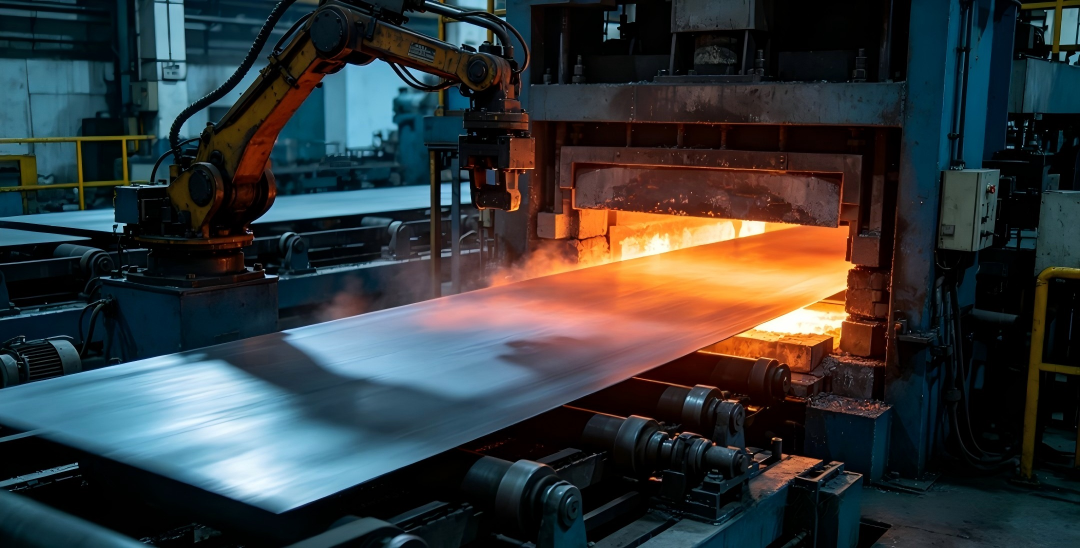
Cutting: The sheet material is cut according to the size of the part. The common practice is to use Al-Si coated sheet to prevent high-temperature oxidation.
2. Heating: The roller-bottom furnace is heated to 880 - 950℃, and then kept at this temperature to allow the steel plate to fully transform into austenite.
3. Transfer and Pressing: The part is quickly transferred to the mold (≤ 5 seconds). While the mold is closing and pressing, it is rapidly cooled and quenched through the mold channels (cooling rate ≥ 30℃/s).
4. Post-processing: Laser edge cutting and punching, and some parts undergo shot peening treatment.
4. Application in Complete Vehicles
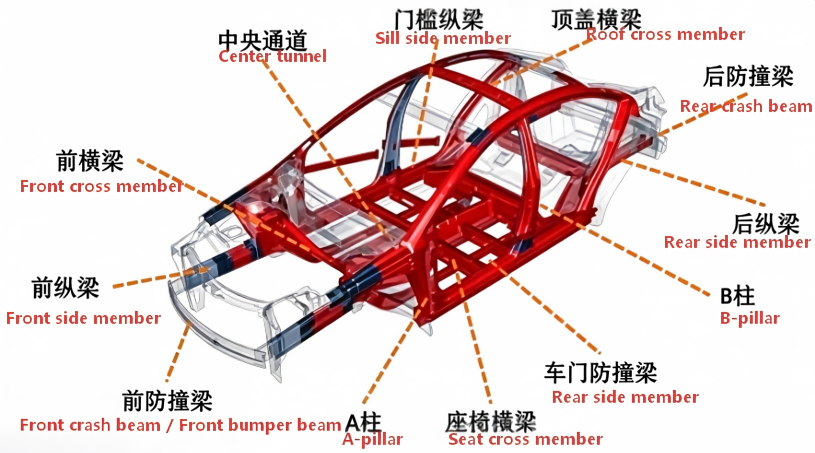
• Core safety components of the passenger cabin: A/B beam reinforcement plates, floor beams, roof crossbeams, and central passageway, which form a high-strength passenger cabin and ensure a safe space for occupants during a collision.
• Impact-resistant load-bearing components: Front impact beam, seat back reinforcement plate, and door impact beam.
• Industry Status: Hot-formed steel for mid-to-high-end vehicle bodies can account for 20% to 30% of the entire vehicle body structure. It is a necessary material that combines extreme lightweighting with collision safety.
5. CAE Simulation Application Directions
• Hot stamping process simulation: Coupled thermo-mechanical-phase transformation calculations are carried out via AutoForm-Hotform and PAM-STAMP to predict temperature field, martensite distribution, hardness uniformity and springback.
• Crash simulation: Failure models such as GISSMO are adopted to accurately characterize the fracture behavior of ultra-high strength steel and verify structural integrity under crash loading conditions.
• Hydrogen embrittlement risk simulation: Combine hydrogen diffusion and stress field to evaluate susceptibility to delayed cracking.
八、 Analysis and Solutions to Common Problems in the Entire Process of High-Strength Steel Production and Service Life
1.Material fatigue failure
Problem description: When the parts are subjected to alternating loads (such as chassis vibration, vehicle body jolting, and door opening/closing impact), micro-cracks start to form at the stress concentration points and gradually expand. Eventually, a sudden fatigue fracture occurs, which is the most common failure mode for chassis components and vehicle structural parts.
Core causes: Stress concentration at structural rounded corners / holes / weld seams; Surface defects of the material; Welding residual tensile stress; Load amplitude exceeding the material's fatigue limit.
Solution:
• Simulation analysis: Utilize fatigue software such as nCode DesignLife and Fe-Safe, and combine the results of static strength / transient dynamics to predict the high-cycle/low-cycle fatigue life; the welded joints are evaluated using the IIW standard hot spot stress method and notch stress method.
• Material selection: Preferentially choose steel grades with high fatigue strength-to-weight ratio, such as CP steel and FB steel chassis-specific steel; select materials with higher surface quality grades to reduce sources of surface defects.
• Design and process optimization: Optimize the radius of structural fillets to avoid abrupt changes in cross-section, and reduce the stress concentration coefficient; Introduce surface residual compressive stress by using shot peening, rolling, and laser shock strengthening; Optimize welding parameters to reduce defects and residual tensile stress.
2. Material corrosion failure
Problem description: In environments with high humidity, salt fog, and acid rain, steel undergoes electrochemical corrosion, resulting in surface rust spots, wall thickness reduction, and in severe cases, perforation and a decrease in structural strength, which affects the durability of the entire vehicle.
Core causes: The substrate is exposed after the coating is damaged; corrosive media such as chloride ions accelerate erosion; water accumulation in the gaps causes local corrosion; electrochemical corrosion occurs due to the contact of different metals.
Solution:
• Simulation analysis: Using software such as COMSOL and MSC Marc, the diffusion of corrosive media and the electrochemical corrosion rate are simulated to predict the wall thickness loss and remaining structural strength after long-term service.
• Material selection: For ordinary environments, a hot-dip galvanizing (GI) coating is used; for coastal / high-salt spray environments, a zinc-aluminum-magnesium (ZM) coating is adopted; the chassis components are made of weather-resistant FB/CP steel.
• Design and process optimization: Drainage holes are reserved in the structural design to prevent the accumulation of water in closed gaps; insulating gaskets are added for the connection of different metals to prevent galvanic corrosion; cathodic electrophoretic coating and weld sealing with adhesive are provided to enhance the anti-corrosion level.
3. Plastic Deformation and Pressing Backlash
Problem description: After cold stamping, the internal stress of the part is released, resulting in rebound and exceeding the dimensional accuracy limit; during service, the load exceeds the yield strength, causing permanent plastic deformation, which affects assembly and functionality.
Core cause: The elastic modulus of high-strength steel is close to that of low-carbon steel, but its yield strength is higher. After forming, the elastic strain energy is large, and the rebound is 2-3 times that of low-carbon steel; the insufficient structural stiffness leads to excessive service stress.
Solution:
• Simulation analysis: Conduct full-process forming rebound simulation using AutoForm and LS-DYNA, and output the compensation amount of the mold surface; perform static strength simulation to verify the stress and deformation under service conditions.
• Material selection: For parts with high dimensional accuracy requirements, steel types with moderate yield strength ratio and stable forming properties should be preferred; for ultra-high-strength parts, the hot forming process can be adopted to fundamentally eliminate the springback.
• Process and design optimization: During the mold design stage, rebound compensation is carried out, and "over-correction" type surface correction is adopted; the shaping process is added, and full material pressing and side shaping are used to control rebound; the structural section is optimized to enhance stiffness and reduce the stress level during service.
4. Cracking during formation
Problem description: During the drawing process, local strain exceeded the forming limit, resulting in necking and fracture; in the bending and reaming processes, the edges of the parts were torn, causing the parts to be scrapped.
Core causes: Insufficient material plasticity and forming limit; Insufficiently large mold fillets and excessive draft angle leading to stress concentration; Poor lubrication and uneven material flow; Narrow forming window for ultra-high strength steel, making it sensitive to process fluctuations.
Solution:
• Simulation analysis: Based on the forming limit diagram (FLD), simulate the risk of drawing cracking, optimize the clamping force, drawing ribs, and the size of the blank; use the edge fracture criterion to predict cracking in bending and expansion.
• Material selection: For complex deep drawing parts, TRIP steel and DP steel with high n value and high elongation are preferred; for parts with high requirements for flanging and drilling, CP steel and FB steel with high drilling rate are selected.
• Process and design optimization: Increase the radius of the mold's rounded corners to reduce stress concentration; Optimize the layout of the drawbeams to balance material flow; Use a dedicated stamping lubricant to reduce friction; When necessary, adopt warm forming to enhance plasticity.
5. Failure of the welded joint
Problem description: During the loading process of resistance spot welding and laser welding joints, interface fractures and core extrusion occur, resulting in a joint strength lower than that of the base material; after ultra-high strength steel welding, the hardened structure is abundant and the toughness decreases, making it prone to brittle fracture.
Core causes: The welding thermal cycle leads to uneven microstructure at the joint, with the melt core becoming hardened and the heat-affected zone becoming softened; improper welding parameters result in spatter and incomplete fusion defects; high-strength steel has a high carbon content, increasing its susceptibility to cold cracking.
Solution:
• Simulation Analysis: Utilizing SYSWELD to simulate the welding temperature field, microstructure evolution, and residual stress, and predict the hardness distribution of the joint; establishing a mechanical simulation model for the joint, and evaluating the failure modes and load-bearing capacity under different loads.
• Material selection: Preferentially select steel grades with low carbon equivalent and good weldability; avoid choosing steel with excessively high strength level in scenarios with high welding requirements.
• Process optimization: Utilize the multi-pulse resistance spot welding process, optimize the current sequence, and improve the shape of the weld core; for laser welding, adopt the wire feeding technique to control the weld structure; after welding of key components, perform low-temperature tempering to reduce the hardness and brittleness.
6. Hydrogen embrittlement and delayed cracking
Problem description: Ultra-high strength steels with a strength of ≥ 1000 MPa and hot-formed steel, during manufacturing or service, absorb hydrogen atoms and undergo delayed cracking without any warning under stress, which is highly concealed and sudden, posing extremely high safety risks.
Core causes: Hydrogen is introduced through processes such as pickling, electroplating, and welding; hydrogen is produced through cathodic reactions in corrosive environments; martensite structure is sensitive to hydrogen, and hydrogen accumulates at grain boundaries and dislocations, reducing the interface bonding strength.
Solution:
• Simulation Analysis: Through hydrogen diffusion simulation, the distribution and enrichment patterns of hydrogen atoms are analyzed, and the risk of hydrogen embrittlement is evaluated based on the stress field; the failure criterion for hydrogen-induced cracking is established, and the critical stress for delayed cracking is predicted.
• Material selection: Select a low hydrogen embrittlement steel type that contains Nb and Ti to refine the grain structure; for the sensitive areas of the welding heat affected zone, select HAZ optimized boron steel.
• Process optimization: Reduce the hydrogen-absorbing process of pickling and instead use low-hydrogen welding materials; perform dehydrogenation annealing after welding; for hot forming, use low-hydrogen Al-Si coating and control hydrogen absorption during the heating process; through process optimization, reduce the residual tensile stress of the parts.
• Inner panels and structural components: Door inner panels, floor reinforcement parts, seat frame accessories, as well as deep-drawn parts such as oil pan and wheel well.


