


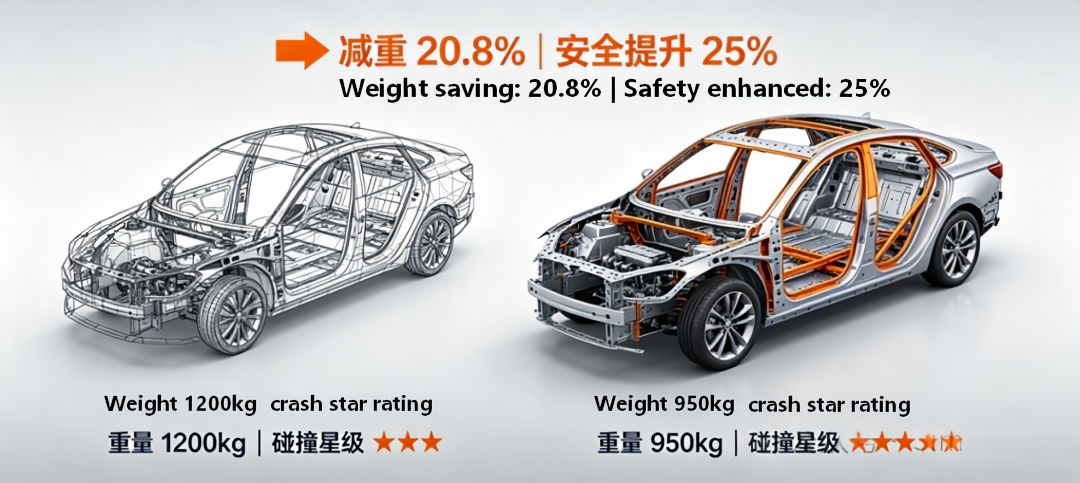
1. Quenching - Alloy Steel (QP): Equivalent to the "forming ceiling" of the same strength level
1. Core concept
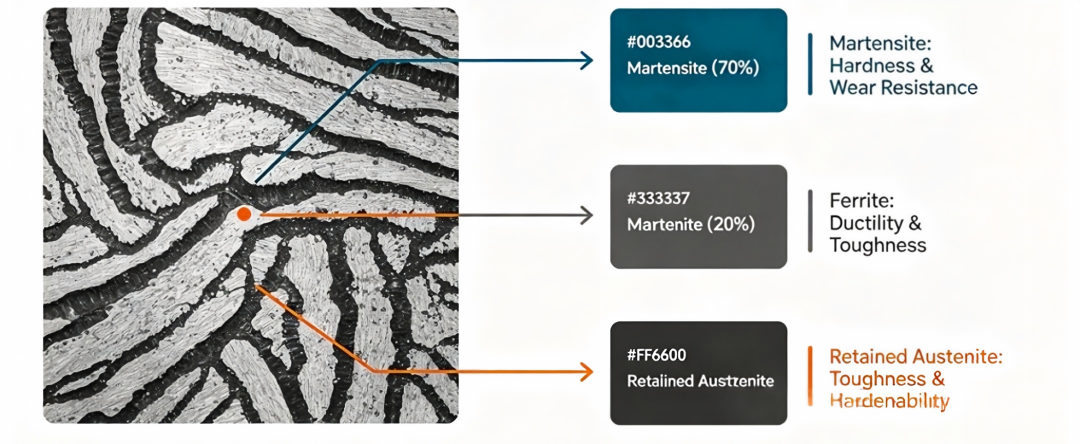
Quenching - Partitioning Steel (QP Steel), a benchmark product of the third-generation advanced high-strength steel, achieves precise control of the microstructure through the unique "quenching - partitioning" heat treatment process: 70% martensite (providing ultra-high strength) + 20% ferrite (ensuring plasticity) + 10% residual austenite (bringing TRIP phase transformation plasticity effect).
The most significant breakthrough lies in the fact that, even at ultra-high strength levels of 980MPa and 1180MPa, it can still maintain an elongation rate and hole expansion performance far exceeding those of DP steel in the same category. This has perfectly solved the industry problem of "high strength inevitably leads to poor formability".
2. Quick Reference of Key Mechanical Properties (Transverse Direction at Room Temperature)
|
Grade |
Yield Strength (MPa) |
Tensile Strength (MPa) |
Elongation after Fracture (A50) |
Typical Yield-to-Tensile Ratio |
Core Advantages |
|
HC600/980QP |
600~850 |
≥980 |
≥15% |
0.61~0.87 |
Balanced Grade |
|
HC600/980QP-EL |
600~850 |
≥980 |
≥20% |
0.61~0.87 |
High Elongation Version (+33%) |
|
HC820/1180QP |
820~1100 |
≥1180 |
≥8% |
0.69~0.93 |
Ultra-High Strength Grade |
|
HC820/1180QP-EL |
820~1100 |
≥1180 |
≥14% |
0.69~0.93 |
Ultra-High Strength & Superior Formability |
✅ Other Key Indicators: Hole expansion rate ≥ 35%, Elastic modulus 206±10 GPa, Poisson's ratio 0.30. The galvanized coating passes 800-hour neutral salt spray test.
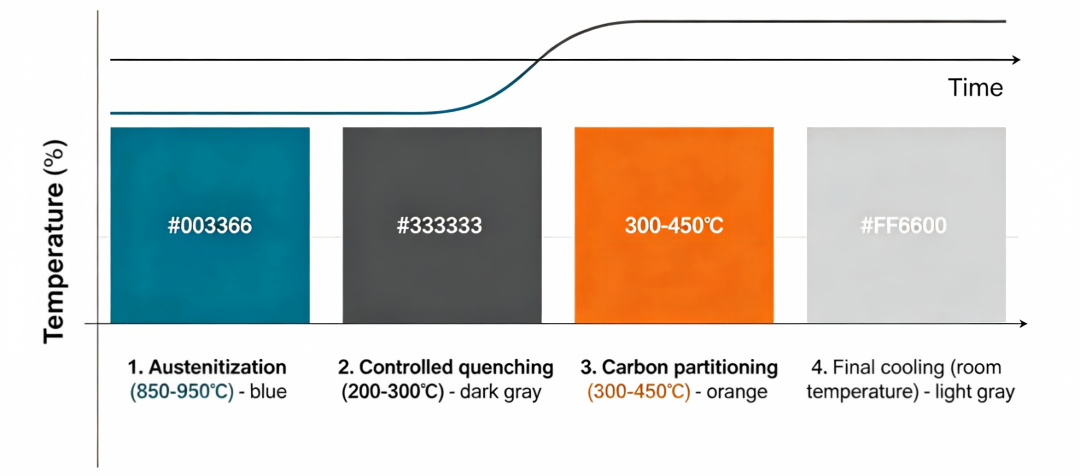
3. Core Production Process (Continuous Annealing)
1.Austenitization: Heat and hold at 850~950℃ to fully austenitize the microstructure.
2.Controlled Quenching: Rapidly cool to a temperature between Ms and Mf (200~300℃) to obtain martensite and untransformed austenite.
3.Carbon Partitioning: Soak at 300~450℃. Carbon diffuses from martensite into austenite to stabilize it.
4.Final Cooling: Cool down to room temperature. Stable retained austenite is preserved, forming a three-phase composite microstructure.
4. Mass Production Application in Complete Vehicles
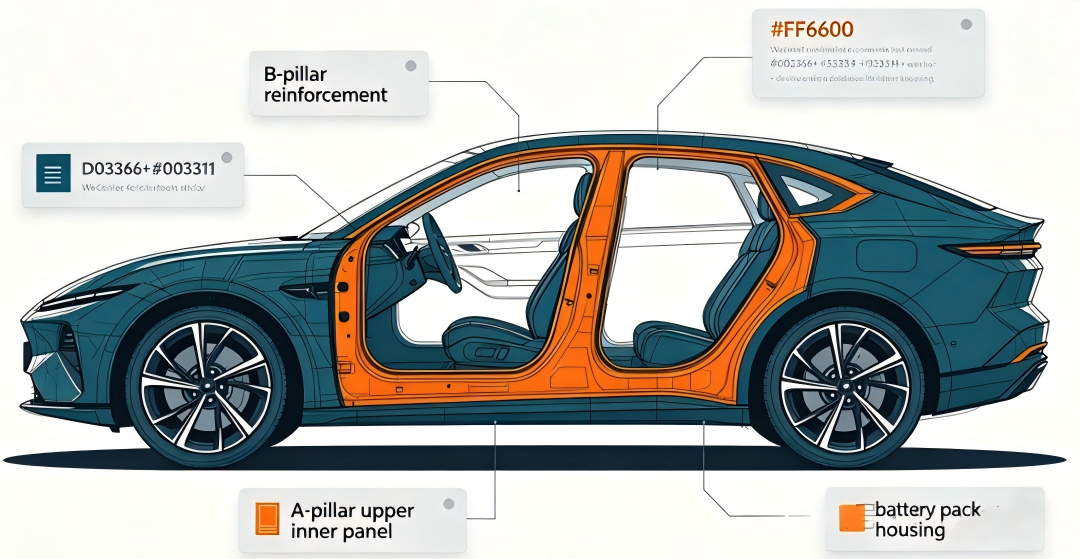
Core application scenarios: Complex-shaped safety components & structural parts for new energy vehicle battery packs
•B-pillar reinforcement, upper inner A-pillar, door impact beam, roof side rail
•Rear section of front side member, seat frame, motor bracket
•Battery pack housing, cross beam and side beam for new energy vehicles
Field Application Cases:
•For B-pillar reinforcement of a domestic brand vehicle: 2.0mm HC600/980QP replaced 2.5mm DP780. It achieved 20% weight reduction and 12% improvement in crash performance.
•For upper inner A-pillar of a joint-venture model: 1.0mm HC600/980QP-Z replaced 1.2mm DP600. The part weight was cut by 16.7%, and the blind area of A-pillar was reduced simultaneously.
•For battery pack lower housing of a new energy vehicle brand: Adopting 1.5mm HC600/980QP-EL for integral stamping. The welding points were reduced by 30%, and structural stiffness increased by 25%.
5. Key Points of CAE Simulation
Pressing and Forming Simulation (AutoForm/Dynaform)
•Recommended Model: Swift/Hockett-Sherby Hybrid Hardening + Yld2000-2d Yield Model
•Required Inputs: True Stress-Strain Curve (up to 10% strain after maximum force), r value, FLD Curve
•Key Focus: Continuous Work Hardening Caused by TRIP Effect, Elastic Modulus Deterioration with Plastic Strain
Collision Safety Simulation (LS-DYNA)
•Basic Model: *MAT_PIECEWISE_LINEAR_PLASTICITY(MAT_24)
•High-Precision Model: *MAT_GISSMO(Considering Stress Triaxiality and the Influence of Roeder Angle on Failure)
•Strain Rate Parameters: C = 40.4, P = 5
•Failure Criterion: Use Stress Triaxiality - Fracture Strain Curve, Do Not Use a Single Maximum Plastic Strain Criterion
2. SAPH Hot-Rolled Steel: The Fundamental Workhorse for Automotive Industry
2.1 Core Concept
SAPH series refers to hot-rolled pickled steel sheets for automotive structural applications manufactured in accordance with JIS G3113 standards. They belong to the low-carbon manganese steel family, with balanced mechanical properties achieved through controlled rolling and controlled cooling processes.
Grade nomenclature breakdown:
S = Steel, A = Automotive, P = Parts, H = Hot-rolled, followed by a number representing the minimum tensile strength in MPa.
Its most prominent feature is low cost, good formability, and excellent weldability, making it the most widely used basic structural steel type in the automotive industry.
2.Quick Reference of Key Mechanical Properties (Longitudinal Direction at Room Temperature)
|
Grade |
Yield Strength (MPa) |
Tensile Strength (MPa) |
Elongation after Fracture (A50) |
Typical Yield-to-Tensile Ratio |
180° Bending |
|
SAPH400 |
≥255 |
≥400 |
≥31% |
0.64 |
D=2a |
|
SAPH440 |
≥305 |
≥400 |
≥29% |
0.69 |
D=3a |
✅ Other Key Indicators: Carbon equivalent ≤ 0.40%; slight softening in the heat-affected zone after welding; surface roughness Ra ≤ 1.6 μm after pickling.
3. Core Production Process
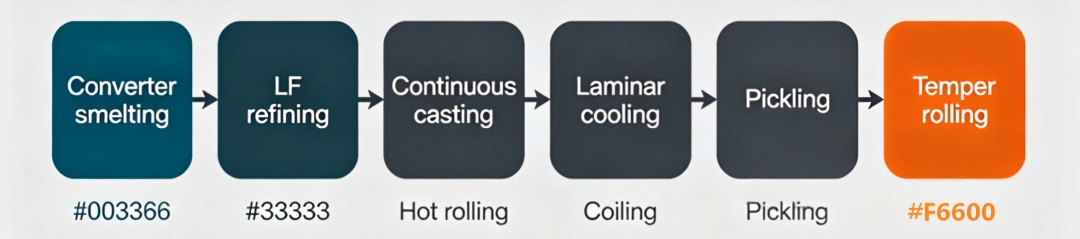
Converter smelting → LF refining → continuous casting → hot strip rolling (finishing temperature: 850~900℃) → laminar cooling → coiling (550~650℃) → pickling → skin pass rolling
4. Application in mass production of complete automobiles
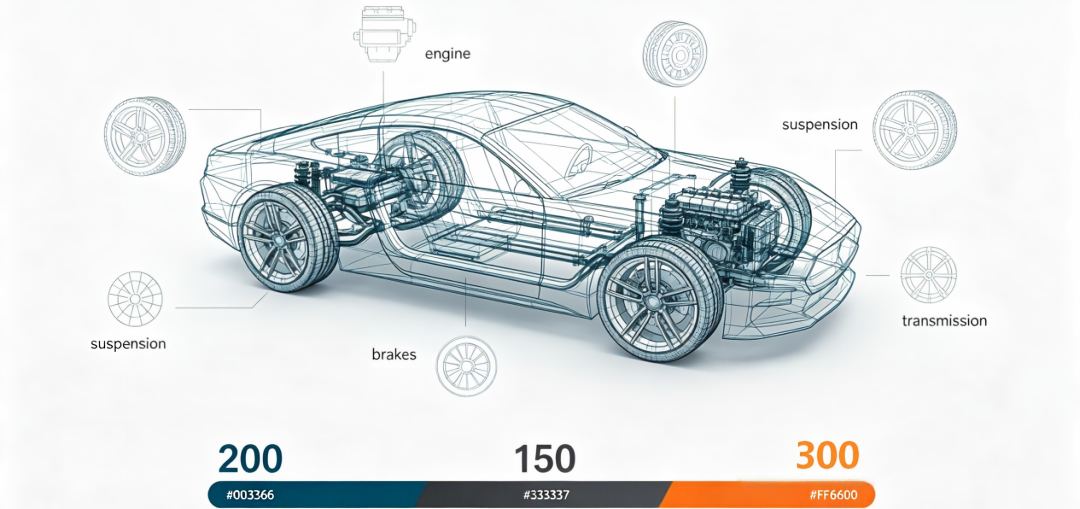
Core application scenarios: Non-critical structural components, chassis parts, wheel systems
• Frame longitudinal beams, transverse beams,doorsill, floor reinforcement beams
• Suspension brackets, subframes, control arms, stabilizer bar mounting seats
• Wheel rims, spokes, fuel tank brackets, door hinges
Real production case:
• A commercial vehicle frame: SAPH440 replaces Q235, the thickness is reduced from 6mm to 5mm, weight is reduced by 16.7%, and cost is decreased by 8%
• The chassis system of an economy car: More than 90% of the bracket-type parts use SAPH400/SAPH440
• A wheel factory: All 15-inch steel wheels are made of SAPH440, and the fatigue life exceeds 1 million times.
Key points of CAE simulation
• Pressurization simulation: Isotropic hardening + Hill48 yield model can meet the accuracy requirements
• Structural strength simulation: *MAT_PLASTIC_KINEMATIC(MAT_3)
• Fatigue simulation: Input standard S-N curve, focus on the welding joint area
• Simulation accuracy: Simple-shaped parts can reach over 95%
三、 High Formability Dual-Phase Steel (DH): Pro Upgraded Version of Conventional DP Steel
1. Core Concept
DH steel is an upgraded grade of 2nd-generation advanced high-strength steel. Its microstructure consists of ferrite, martensite, a small amount of retained austenite and bainite.
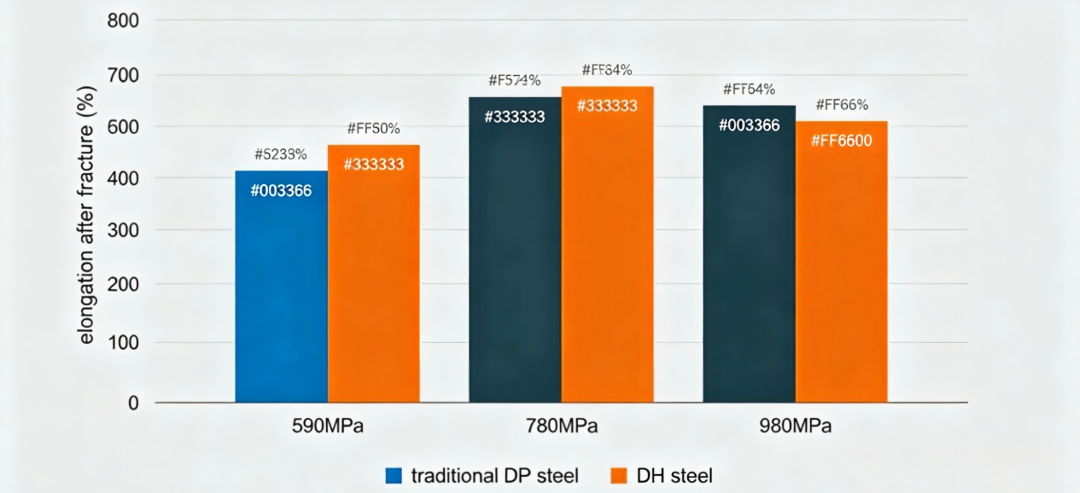
Compared with conventional DP steel of the same strength grade, stabilized retained austenite is introduced to generate the TRIP effect, boosting elongation by 30%~75%. It perfectly solves the pain point of easy cracking during forming complex components when using traditional DP steel.
2.Quick Reference of Key Mechanical Properties (Longitudinal Direction at Room Temperature)
|
Grade |
Yield Strength (MPa) |
Tensile Strength (MPa) |
Elongation after Fracture (A50) |
Typical Yield-to-Tensile Ratio |
Elongation of DP Steel at Equivalent Strength Grade |
Improvement Margin |
|
HC330/590DH |
330~440 |
590~700 |
≥27% |
0.56~0.75 |
≥22% |
+23% |
|
HC440/780DH |
420~550 |
780~900 |
≥19% |
0.54~0.71 |
≥15% |
+27% |
|
HC700/980DH |
700~850 |
980~1180 |
≥14% |
0.71~0.87 |
≥8% |
+75% |
✅ Other key indicators: Expansion rate ≥ 35%\40%, n value ≥ 0.13\0.16, the hardening ability during processing is significantly superior to that of traditional DP steel.
3. Core production process (Continuous annealing)
1. Heating in the two-phase zone (780 - 850℃): Achieve a mixed structure of ferrite and austenite
2. Rapid cooling to the bainite zone (350 - 450℃)
3. Post-ageing treatment: Bainite transformation + carbon distribution, stabilizing residual austenite
4. Final cooling to room temperature
4. Mass production application of complete vehicle
Core application scenarios: High-strength forming reinforcement components, anti-collision energy absorption components
• Front longitudinal beams, rear longitudinal beams, floor longitudinal beams,门槛 reinforcement plates
• Front anti-collision beams, rear anti-collision beams, door anti-collision beams
• Seat frames, battery pack structural components, chassis reinforcement components
Real mass production cases:
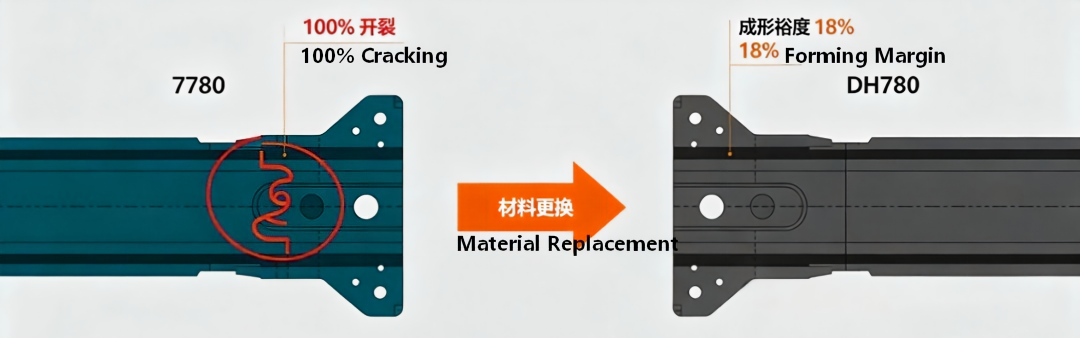
• Front longitudinal beam of a certain model: Traditional DP780 cracked 100% in the S-shaped transition zone, after replacing with DH780, the forming was good, and the forming margin increased from 5% to 18%
• Floor upper longitudinal beam of a certain joint venture model: 1.2mm HC700/980DH replaced 1.4mm DP780, weight reduction of 14.3%
• DH steel of Shougang has been supplied in batches to mainstream automakers such as Mercedes-Benz, FAW, and Great Wall
5. Key Points of CAE Simulation
• Pressurization Simulation: The Yld2000-2d yield model must be used; otherwise, the cracking prediction error can be as high as over 30%
• Collision Simulation: Similar to QP steel, the GISSMO damage model is recommended
• Key Focus: Shear fracture failure mode. The traditional maximum principal strain criterion will significantly overestimate the forming limit
四、 Ultimate Comparison & Material Selection Guide for Three Grades
1. General Comparison Table of Core Properties
|
Material Type |
Strength Grade (MPa) |
Typical Yield-to-Tensile Ratio |
Elongation Range |
Formability |
Weldability |
Cost Index |
|
SAPH Series |
400~440 |
0.64~0.69 |
29%~31% |
Excellent |
Excellent |
1.0 |
|
DH Series |
590~980 |
0.54~0.87 |
14%~27% |
Good+ |
Good |
1.3 |
|
QP Series |
980~1180 |
0.61~0.93 |
8%~20% |
Good |
Good |
1.6 |
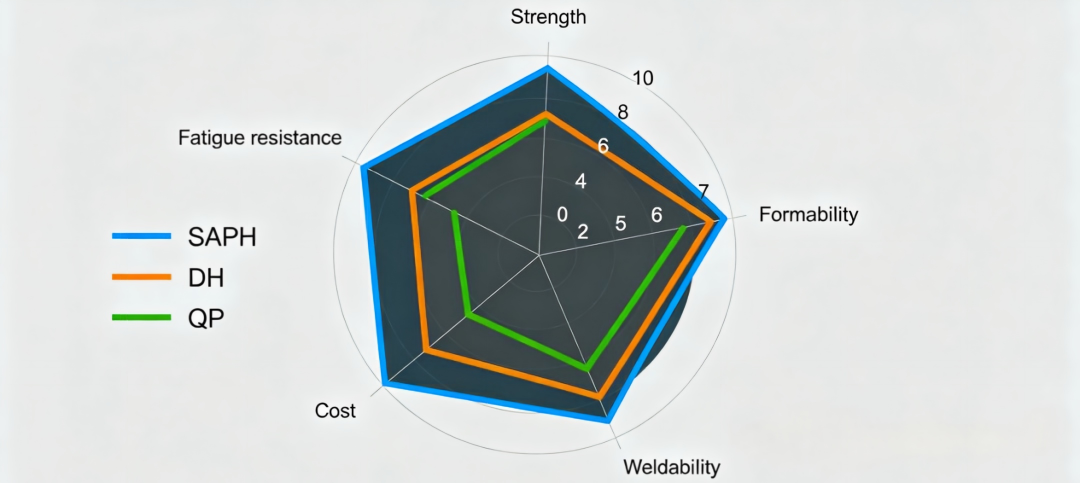
2. Four-step selection decision-making method
1. Check the strength requirements:
○ ≤ 440 MPa: The SAPH series is the first choice, with the lowest cost
○ 590 - 980 MPa: The DH series should be prioritized, as it offers the highest cost-effectiveness
○ ≥ 980 MPa: The QP series must be used, as it provides the best formability for the same strength
2. Consider the complexity of the forming process:
○ Simple bending, shallow stretching: Traditional DP steel is sufficient
○ Complex stretching, multi-pass forming: DH series
○ Involving flanging, drilling, and local large deformation: QP-EL series
3. Consider the safety level:
○ Non-critical structural components: SAPH
○ General safety components: DH
○ Core safety components (A/B columns, longitudinal beams): QP
4. Consider special requirements for new energy:
○ Battery housing: Prefer HC600/980QP-EL, taking into account strength, formability and impact resistance
○ High lightweighting requirements: Prefer the version with high elongation (EL), which can achieve a greater reduction in thickness
五、Future Development Trends
The strength has been further enhanced: 1500MPa and 1800MPa grade QP steel has entered the mass production verification stage.
2. Cost continues to decrease: Through optimization of alloy composition and process improvement, the cost of QP steel will gradually approach that of DP steel.
3. Specialized Development: Develop specialized steel grades specifically for components such as battery packs and motors in new energy vehicles.
4. Enhancement of simulation accuracy: Multi-scale coupling simulations considering phase change kinetics will become the mainstream.
The development of advanced high-strength steel at the end is reshaping the methodology of car body design. From the initial "trade-off of thickness for strength" to the current "winning through precision", every breakthrough in material performance has brought a qualitative leap to car lightweighting and safety performance.
Discussion topic: Which advanced high-strength steels have you used in your work? Have you encountered any problems in forming or simulation? Please feel free to email: market@so-lucky.cn.


