


The CR, HR, LA, and CL series of brands, which are frequently encountered in daily use, may seem to have simple naming conventions. However, behind each of them lies a different composition design, production process, performance boundary, and applicable scenario. Incorrect selection can not only cause forming and welding problems, but also potentially lay the groundwork for failure hazards such as fatigue and corrosion.
This article summarizes the concept attributes, mechanical properties, production processes and vehicle application scenarios of the four major series of mainstream brands. At the same time, it provides CAE simulation methods and common failure solutions in production use, making it convenient for engineers in positions such as materials, stamping, body, and CAE to quickly refer to.
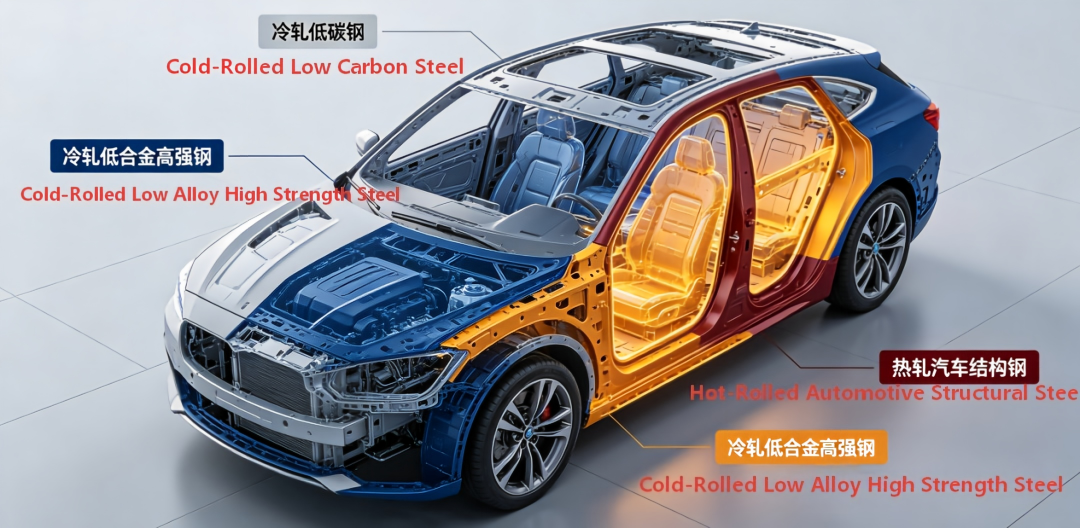
一、 Overview of the material system and naming rules for grades
This naming system for plate numbers is a globally applicable standard for cold-formed steel plates in the automotive industry. Its core naming logic is based on the rolling process, strength grade, and application characteristics:
• Prefix: CR = Cold Rolled, HR = Hot Rolled, HD = Hot Dip Galvanized Hot Rolled
• Low-carbon mild steel: The suffix numbers represent the forming grades, ranging from 1 to 5, which are in sequence: stamping grade → deep drawing grade → ultra-deep drawing grade → extra-deep drawing grade → ultra-extra-deep drawing grade.
• Low-alloy high-strength steel (with "LA" suffix): The middle number represents the minimum yield strength (in MPa). "LA" stands for low alloy micro-alloying (Low Alloy). It achieves a balance between strength and plasticity through trace elements such as Nb, Ti, and V.
•Structural steel (with CL suffix): The middle number represents the minimum tensile strength (MPa). CL stands for Cold Forming Structural, emphasizing the bending and rolling forming properties, and is mainly used for wheels and frames.
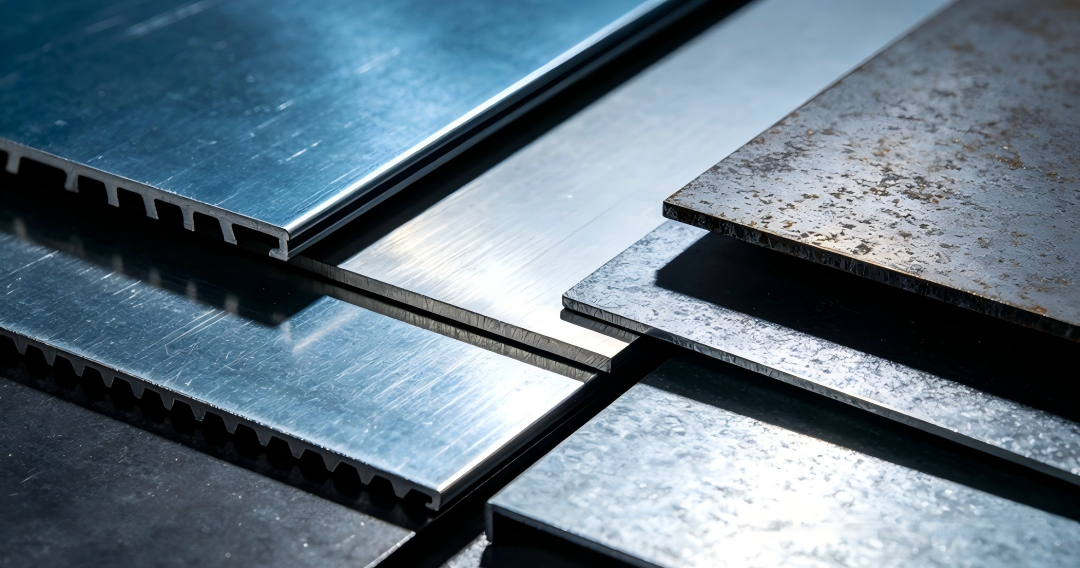
- Conceptual Attributes and Core Performance of Each Series of Materials
2.1 Cold-Rolled Mild Steel
The concept property of low-carbon quenched steel / IF steel with a carbon content of ≤ 0.12% is produced through cold rolling + annealing processes. Its core characteristics include excellent plasticity, good formability, excellent weldability, and low cost. It is the basic material for automotive body panels and simple structural components, accounting for more than 40% of the cold-rolled steel sheet usage in the vehicle body.
• Physical base parameters: Density 7.85 g/cm³, Elastic modulus 206 GPa, Poisson's ratio 0.3, Thermal expansion coefficient 11.7×10⁻⁶/℃
• Chemical properties: The corrosion resistance of the bare board is average. It needs to be used in combination with electrophoresis, coating or plating; The low-carbon design ensures excellent weldability, and is suitable for all conventional welding processes such as spot welding, arc welding, and laser welding. Core mechanical properties (transverse specimens, thickness 0.8 - 2.0mm)
Core mechanical properties (transverse specimens, thickness 0.8 - 2.0 mm)
|
Grade |
Yield Strength Range (MPa) |
Tensile Strength Range (MPa) |
Elongation after Fracture A80 (≥ %) |
Typical Yield-to-Tensile Ratio |
Formability Grade |
Corresponding National Standard Reference |
|
CR1 |
140-300 |
270-410 |
28 |
0.65 |
Stamping Grade |
DC01 |
|
CR2 |
140-240 |
270-370 |
34 |
0.60 |
Deep Drawing Grade(DD) |
DC03 |
|
CR3 |
140-210 |
270-350 |
38 |
0.56 |
Extra Deep Drawing Grade(EDD) |
DC04 |
|
CR4 |
140-180 |
270-330 |
39 |
0.53 |
Special Extra Deep Drawing Grade |
DC05 |
|
CR5 |
110-170 |
260-330 |
41 |
0.47 |
Ultra Deep Drawing Grade(UDD) |
DC06 |
Note: The yield-to-tensile ratio is calculated based on typical median values, specifically [(upper yield limit + lower yield limit) / 2] ÷ [(upper tensile limit + lower tensile limit) / 2], the same applies hereinafter. The larger the number in the grade designation, the better the formability, the lower the yield-to-tensile ratio, and the stronger the drawing deformation capacity.
2.2 Cold Rolled HSLA Steel
Concept & Characteristics
Trace alloy elements such as Nb, Ti and V are added to low-carbon steel. Its strength is improved through grain refinement strengthening and precipitation strengthening mechanisms. Classified as conventional high-strength steel, it covers a yield strength range of 210–460 MPa.
While achieving higher strength, it maintains favorable cold formability and weldability. As a primary lightweight material for automotive body structural parts, it enables a thickness reduction of 10%–20% compared with low-carbon steel for equivalent structural performance.
Core Mechanical Properties (Transverse specimens, thickness: 0.8~2.5 mm)
|
Grade |
Yield Strength Range (MPa) |
Tensile Strength Range (MPa) |
Elongation after Fracture A80 (≥ %) |
Typical Yield-to-Tensile Ratio |
|
CR210LA |
210~300 |
310~410 |
31 |
0.71 |
|
CR240LA |
240~320 |
320~430 |
28 |
0.74 |
|
CR270LA |
270~350 |
350~460 |
26 |
0.76 |
|
CR300LA |
300~380 |
380~490 |
23 |
0.78 |
|
CR340LA |
340~430 |
410~530 |
21 |
0.82 |
|
CR380LA |
380~470 |
450~570 |
19 |
0.83 |
|
CR420LA |
420~520 |
480~600 |
17 |
0.85 |
|
CR460LA |
460~580 |
520~680 |
15 |
0.87 |
2.3 Hot Rolled Low Alloy High-Strength Steel (Hot Rolled HSLA)
Conceptual Attributes
Hot-rolled micro-alloy high-strength steel produced by the controlled rolling and controlled cooling (TMCP) process, with thickness specifications ranging from 1.5mm to 12mm, has a strength range of 300 to 500 MPa at the yield point. Compared to cold-rolled HSLA, the hot-rolled specifications are thicker and have better strength and toughness matching, making them suitable for thick-walled load-bearing structural components and chassis parts.
Among them, HD340LA is the hot-dip galvanized version, with the base material's mechanical properties being the same as HR340LA, and an additional hot-dip galvanizing coating is added to the surface, increasing corrosion resistance by 3 to 5 times, suitable for corrosive harsh scenarios such as chassis.
Core mechanical properties (transverse specimens, thickness 2.0 - 6.0 mm)
|
Grade |
Yield Strength Range (MPa) |
Tensile Strength Range (MPa) |
Elongation after Fracture A80 (≥ %) |
Typical Yield-to-Tensile Ratio |
|
HR300LA |
300~380 |
380~500 |
26 |
0.79 |
|
HR340LA |
340~440 |
410~530 |
24 |
0.82 |
|
HD340LA |
340~440 |
410~530 |
24 |
0.82 |
|
HR380LA |
380~480 |
450~580 |
22 |
0.83 |
|
HR420LA |
420~520 |
480~600 |
22 |
0.86 |
|
HR460LA |
460~560 |
520~650 |
20 |
0.87 |
|
HR500LA |
500~620 |
550~700 |
18 |
0.89 |
2.4 Hot Rolled Structural Steels (for Automobiles)
Conceptual Attributes
Hot-rolled steel specifically developed for automotive cold forming structural components. The microstructure is mainly composed of uniform ferrite + pearlite. It focuses on optimizing cold bending and rolling forming performance as well as fatigue resistance. It is particularly suitable for processes such as wheel rolling profiles and frame bending. Compared to HSLA steel of the same strength, it has a lower yield-to-strength ratio, better bending forming performance, and superior impact and fatigue resistance.
Core mechanical properties (transverse specimens, thickness 2.0 - 8.0 mm)
|
Grade |
Yield Strength Range (≥MPa) |
Tensile Strength Range (MPa) |
Elongation after Fracture A80 (≥ %) |
Typical Yield-to-Tensile Ratio |
Core Characteristics |
|
HR330CL |
225 |
330~430 |
33 |
0.72 |
Excellent cold bending performance, suitable for passenger car wheel rims |
|
HR420CL |
305 |
420~540 |
29 |
0.76 |
Balanced bending resistance and strength, applicable to light truck wheels and frames |
|
HR450CL |
335 |
450~570 |
27 |
0.77 |
High strength and high toughness, ideal for heavy truck wheel discs |
|
HR500CL |
380 |
500~620 |
24 |
0.79 |
High load-bearing capacity, matching heavy-duty frames and axle housings |
三、Detailed Introduction to Manufacturing Processes
3.1 Manufacturing Process of Cold-Rolled Low-Carbon Mild Steel
• Key Process 1: Annealing
Steel sheets produced via batch annealing deliver superior formability, suitable for deep-drawing grades CR3~CR5; continuous annealing features high production efficiency and consistent material properties, matching ordinary stamping grades CR1~CR2.
• Key Process 2: Temper rolling
Temper rolling with small reduction eliminates yield plateau, improves surface quality and prevents Lüders band defects during stamping.
• High-end products: CR4 and CR5 grades mostly adopt IF steel (Interstitial Free steel) composition design. Alloy elements Ti and Nb are added to immobilize C and N atoms, achieving ultra-low yield strength and ultra-high elongation.
3.2 Manufacturing Process of HSLA (High Strength Low Alloy) Steel
• Hot-rolled HSLA
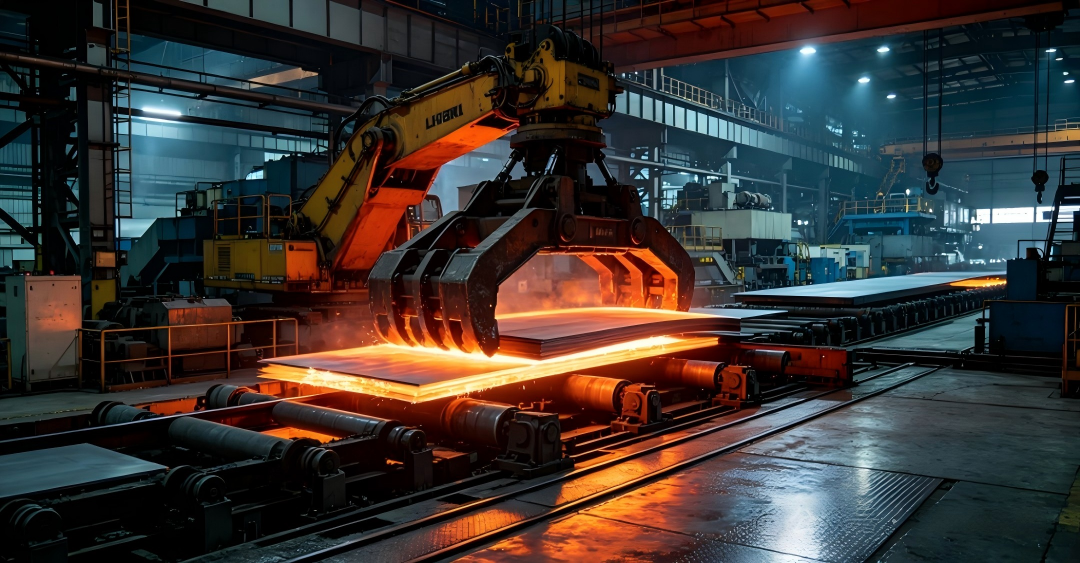
Precisely control the addition of microalloy elements Nb, Ti and V during steelmaking. Low-temperature heavy reduction controlled rolling is adopted in the finishing mill, combined with laminar accelerated cooling. Strength and toughness are simultaneously improved by grain refinement strengthening and precipitation strengthening, and target mechanical properties can be obtained without subsequent heat treatment.
• Cold-rolled HSLA
Hot-rolled HSLA coils are used as raw materials. After pickling and cold rolling to reduce thickness, continuous annealing is carried out to regulate recrystallization and precipitated phases, so as to produce cold-rolled products with balanced strength and formability.
3.3 Manufacturing Process of Hot-Rolled Structural Steel (CL Series)
Adopt the hot continuous rolling route. Strictly control the finish rolling temperature and coiling temperature to obtain uniform ferrite + pearlite microstructure, and tightly restrain the banded structure grade. The finished steel boasts outstanding formability with no cracks under 180° cold bending.
Meanwhile, the purity of molten steel is optimized to reduce inclusion content and extend the fatigue resistance life of components such as wheels.
四、. Expansion of Industrial and Full-vehicle Applications
4.1 Application of Cold-Rolled Low-Carbon Soft Steel
•CR1: Simple stamping parts, such as engine compartment cover plates, fuel tank partitions, seat accessories, door brackets, various reinforcing gaskets, and general structural components with low forming requirements.
•CR2: Common deep drawing parts, such as door inner panels, luggage compartment cover plates, front fenders, floor trim strips, wheel well inner panels.
•CR3 - CR4: Complex covering parts and inner plates, such as engine hood outer plates, side panels, roof covers, door outer panels, and instrument panel frameworks.
•CR5: Ultra-deep drawing parts, such as oil pans, complex stretch-inners, threshold inner plates, and complex-shaped stretch-type structural components.
4.2 Application of Cold-Rolled Low-Alloy High-Strength Steel
• **Low-intensity grade (CR210LA\CR300LA)**: Body reinforcement components, such as door impact beam reinforcement plates, floor threshold reinforcement parts, seat frame, and floor crossbeam, are used to replace low-carbon steel, achieving a 10% - 15% weight reduction.
• Medium-high strength grade (CR340LA ~ CR460LA): The main load-bearing structure of the vehicle body, such as B-pillar reinforcement plates, floor beam, front longitudinal beam reinforcement components, seat slides, and bumper mounting seats, are the main materials for ensuring the structural safety of the complete vehicle body.
4.3 Application of Hot-Rolled Low-Alloy High-Strength Steel
• Chassis system: Subframe, control arms, stabilizing bars, rear axle housing, shock absorber brackets, capable of withstanding high impact and alternating loads.
• Body structure: Front / rear longitudinal beams, bumper crossbeams, floor reinforcement components, etc., thick-walled energy-absorbing structures.
• Galvanized version (HD series): Lower arms of the chassis, subframes, etc., for components in harsh corrosive environments, do not require additional painting to meet 5 to 8 years of corrosion resistance requirements.
4.4 Application of Hot-Rolled Structural Steels (CL Series)
• Wheel System: HR330CL is used for the wheel rims of Passenger vehicles rolling type wheels; HR420CL/HR450CL are used for the wheel spokes and rims of commercial vehicles, suitable for the rolling forming process, with excellent shock resistance and fatigue resistance.
• Frame and crossbeam: Longitudinal beams of heavy-duty truck frames, vehicle body skeletons of buses, and side panels of compartments, all require long-sized structural components with high bending resistance performance.
• Others: Transmission shaft tubes, drive axle housings, container side panels, etc., are all cold-formed structural components.
五、 Expansion of CAE Simulation Applications
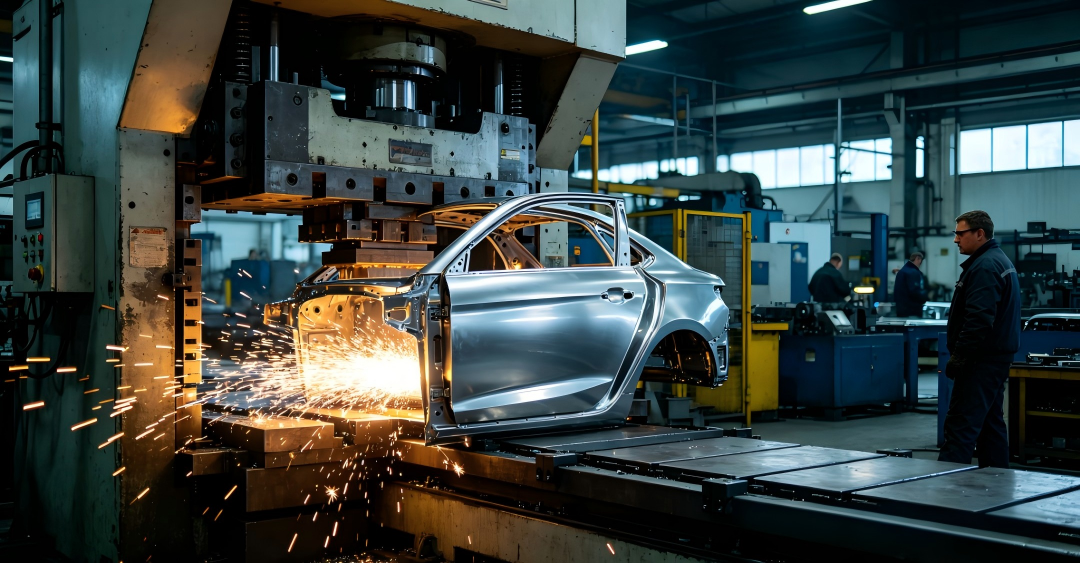
5.1 Pressing Forming Simulation
• Core tools: AutoForm, Dynaform, LS-DYNA
• Material model: General *MAT_024 elastic-plastic anisotropic material model, combined with Hill48 yield criterion, with input of r value, n value, stress-strain curve, and FLD forming limit diagram.
• Core application scenarios:
a. Defect prediction for forming: Early identification of risks such as stretching cracking, wrinkling, and excessive thinning, optimization of clamping force, stretching ribs layout, and blank shape, reducing the number of on-site mold trials.
b. Residual deformation prediction and compensation: High-strength steel has a high yield strength ratio and large residual deformation. Through simulation, the residual deformation amount is accurately calculated, and the mold surface is compensated in reverse, increasing the trial mold success rate by more than 60%.
c. Material selection verification: Comparing the forming limits of different grades, under the premise of meeting the strength requirements, selecting the material scheme with the best forming performance and the lowest cost.
5.2 Collision Safety Simulation
• Core tools: LS-DYNA, ABAQUS/Explicit
• Material models: Employ an elastoplastic material model that takes into account the strain rate effect. Input the Cowper-Symonds strain rate parameters to accurately simulate the material strengthening behavior under high-speed collisions.
• Core application scenarios:
a. Whole vehicle crashworthiness analysis: Under positive impact, side impact, and roof compression conditions, evaluate the structural energy absorption capacity and occupant compartment intrusion volume, and optimize the material strength matching for different parts - select materials with a slightly lower yield strength ratio in the energy absorption zone and a wider plastic deformation range, and select high yield strength ratio and high-strength materials in the anti-intrusion zone.
b. Component-level performance verification: Special simulations such as bumper low-speed impact, door side impact, and seat strength, to verify whether the material selection meets regulatory and performance requirements.

5.3 Fatigue Durability Simulation
• Core tools: nCode DesignLife, MSC Fatigue, FEMFAT
• Core application scenarios:
a. High-cycle fatigue analysis: Based on the S-N stress-life method, evaluate the fatigue life of components subjected to alternating loads such as chassis parts and wheels, locate stress concentration zones, and disperse stress via structural optimization.
b. Weld fatigue assessment: Adopt the structural stress method to calculate the fatigue life of spot welds and arc welds, and optimize weld layout and welding procedures.
c. Corrosion-fatigue coupling analysis: Combine environmental corrosion rates to evaluate the long-term fatigue life of coated or painted components.
六. Common Problems & Solutions in Material Production and Application
6.1 Fatigue Failure
Problem description: Under long-term alternating loads, fatigue cracks initiate at stress concentration sites (holes, fillets, weld seams) and propagate until fracture. This is the primary failure mode for chassis, wheel and body structural components.
Solutions:
• Simulation optimization: Calculate full-service-life fatigue performance via fatigue simulation software to identify high-risk zones. Reduce stress concentration by enlarging fillet radii, adding reinforcing ribs and adjusting wall thickness.
• Material selection: For components with strict fatigue requirements, use killed steel with superior inclusion control, such as CL-series wheel-dedicated steel, which delivers 10%~15% higher fatigue strength than conventional steel of equivalent tensile strength.
• Process enhancement: Introduce compressive residual stress through surface strengthening processes including shot peening and roller burnishing; optimize welding parameters to minimize weld defects and tensile residual stress.
6.2 Corrosion Failure
Problem description: Electrochemical corrosion occurs when materials are exposed to humid, salt-spray or de-icing agent environments, causing wall thickness reduction and degraded mechanical properties. Severe corrosion results in perforation, commonly found on chassis, lower body panels and wheel arches.
Solutions:
• Surface protection: Prioritize hot-dip galvanized and zinc-aluminum-magnesium coated steel sheets (HD series). Combined with electrophoretic coating and PVC chassis sealant, the corrosion service life can be extended by 3 to 10 times.
• Structural design: Eliminate enclosed water-trapping cavities; design drain holes and vent holes to mitigate accelerated corrosion caused by trapped liquid and dust accumulation.
• Material upgrade: For extremely corrosive environments, switch to coatings with superior corrosion resistance or adopt supplementary cathodic protection systems.
6.3 Plastic Deformation Failure
Problem description: Irreversible plastic deformation takes place when components endure overload or impact loads, leading to dimensional tolerance out-of-spec and functional failure. Typical cases include bumper crash deformation, frame bending and seat frame distortion.
Solutions:
• Simulation analysis: Conduct static strength and impact finite element analysis to calculate stress-strain distribution and deformation magnitude, and assess structural load capacity in advance.
• Material upgrade: Select grades with higher yield strength, e.g., upgrade from CR340LA to CR420LA, or HR340LA to HR420LA, to boost deformation resistance.
• Structural optimization: Adjust cross-sectional geometry and add reinforcing ribs to improve structural stiffness and distribute localized loads.
6.4 Cracking Failure
6.4.1 Description of Pressing Cracking Problem: During the pressing process, local deformation exceeds the material's forming limit, resulting in microscopic or macroscopic cracking, which is the most common defect in press production.
Solution:
• Pre-simulation: Use software like AutoForm to simulate the entire pressing process, predict the cracking area, and optimize the clamping force, increase the mold radius, and adjust the resistance of the drawing ribs.
• Material Optimization: For complex drawing parts, select materials with a higher elongation rate and a larger n value, such as using CR3 instead of CR1 for deep-drawing parts and prioritizing low yield strength HSLA steel for high-strength parts.
• Process Improvement: Use high-performance pressing oil to enhance lubrication effect, optimize the blank contour, and reduce local deformation concentration.
6.4.2 Description of Service Cracking Problem: During the service of the component, it is subjected to impact or alternating loads, resulting in brittle cracking or fatigue expansion cracking, which mostly occurs at weld seams and stress concentration areas.
Solution:
• Toughness Evaluation: Through fracture toughness simulation and low-temperature impact tests, verify the risk of low-temperature brittleness of the material. High-altitude regions should prioritize high-toughness HSLA steel.
• Welding Control: Before high-strength steel welding, appropriately preheat, control the line energy, and avoid cold cracks; perform stress relief treatment after welding to reduce residual stress.
• Structural Optimization: Eliminate stress concentration sources such as sharp corners and sharp edges, and smooth the transition sections.
6.5 Excessive Springback
Problem Description: After press forming, the part has a deviation in size from the design due to elastic recovery, resulting in insufficient assembly accuracy for high-strength steel with a higher yield strength ratio. The higher the yield strength ratio, the more significant the springback, leading to insufficient assembly accuracy.
Solution:
• Simulation Compensation: Precisely predict the springback amount through press simulation, perform reverse geometric compensation on the mold surface, which is currently the mainstream and efficient method for controlling the springback of high-strength steel pressing.
• Process Optimization: Add finishing processes, extend the holding time, and use hot forming or cold finishing processes to reduce springback.
• Material Balance: Prioritize materials with a slightly lower yield strength ratio to reduce the difficulty of springback control and mold costs.
6.6 Welding Defects and Failures
Problem Description: Small weld nuggets, false welding, and welding cracks occur, resulting in insufficient joint strength, and weld points or weld seams fall off during service.
Solution:
• Parameter Optimization: Low-carbon steel and HSLA steel have excellent welding properties. Adjust the welding current, pressure, and energization time to match the optimal parameters; for galvanized steel, adopt a three-stage welding process to reduce spatter and false welding.
• Material Control: Strictly control the carbon content of HSLA steel to be ≤ 0.45% to ensure the cold cracking sensitivity is at a low level.
• Simulation Verification: Use SORPAS and other welding simulation software to simulate the formation process of the weld nugget, and quickly optimize the welding process parameters.
七、Conclusion
The four major steel series cover most application scenarios of automobiles, ranging from outer body panels to chassis structural components. The core logic for material selection is as follows: low-carbon deep-drawing steel shall be prioritized for exterior panels to guarantee excellent formability; HSLA steel is the optimal choice for structural parts to balance strength and lightweight performance; CL-series structural steel is recommended for cold-bent or roll-formed components such as wheels and frames, which requires both favorable formability and outstanding fatigue resistance.
Combined with CAE simulation technologies including stamping, crash and fatigue analysis, material performance can be verified in advance during the development phase to avoid potential failure risks. This approach significantly shortens development cycles and cuts trial-and-error costs, and has become the standardized development workflow for current automotive material engineering.
Core process flow: Converter steelmaking → Continuous casting → Hot rolling (rough rolling + finish rolling) → Laminar cooling & coiling → Pickling → Cold rolling → Annealing → Temper rolling → Finishing & slitting


