


一、 Material Nature: The Most Consumed Advanced High-Strength Steel for Auto Bodies
High-Strength Interstitial-Free (HS-IF) steel serves as the core grade of the first-generation advanced high-strength steel (AHSS). Developed based on ultra-low carbon IF steel (C ≤ 0.01%), it adopts phosphorus-manganese solid-solution strengthening combined with titanium/niobium microalloying technology.
Core Mechanism
Ti and Nb elements fully immobilize residual interstitial C and N atoms in steel to form stable precipitates, leaving nearly no free interstitial atoms within the ferrite matrix. This delivers three irreplaceable advantages:
• Complete elimination of yield point elongation, free of Lüders bands during stamping
• Extra-high plastic strain ratio (r-value), far superior deep drawability compared with conventional low-carbon steel
• No room-temperature aging effect; mechanical properties remain stable after storage for over six months
Grade Naming Convention
Format breakdown:
B 170 P 1
└─┘ └─┘ └─┘ └─┘
Mill Code | Yield Strength | Strengthening Type | Quality Grade
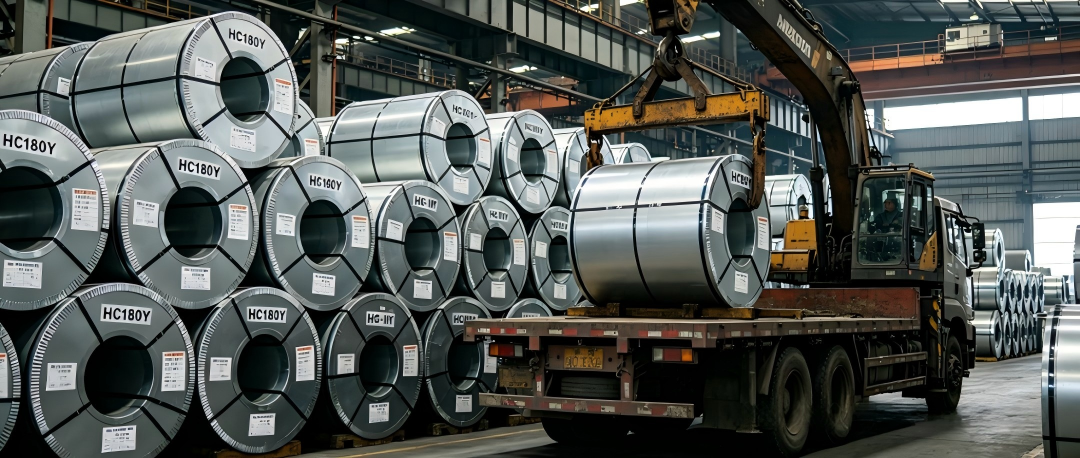
Mill Code: B = Baosteel; HC = National Standard grade
Strengthening Type: P = Phosphorus-strengthened; Y = Yield-type; LY = Low yield point
Suffix Explanation D: Hot-dip galvanized substrate +Z: Pure zinc coating +ZF: Zinc-iron alloy coating
Comparative Positioning with Other Steel Grades
|
Steel Grade |
Yield Strength (MPa) |
Yield-to-Tensile Ratio |
Deep Drawability (r₉₀ Value) |
Main Applications |
|
Conventional Low-Carbon Steel (DC04) |
140~180 |
0.45~0.55 |
1.8~2.0 |
Simple Outer Panels |
|
HS-IF Steel |
170~260 |
0.50~0.76 |
1.5~1.7 |
Complex Outer Panels / Structural Components |
|
High-Strength Low-Alloy Steel (HSLA) |
260~420 |
0.70~0.80 |
1.0~1.2 |
Simple Structural Parts |
|
Dual-Phase Steel (DP590) |
350~450 |
0.75~0.85 |
0.8~1.0 |
Crash-Resistant Structural Members |
二、 Core Mechanical Properties of Full Product Series
All performance data are obtained from room-temperature tensile tests on transverse specimens; yield-to-tensile ratios represent typical mill reference values.
|
Grade |
Yield Strength, Rp0.2 (MPa) |
Tensile Strength, Rm (MPa) |
Total Elongation A80 (%) |
Yield-to-Tensile Ratio (Typical Value) |
r90(≥) |
n90(≥) |
Relevant Standards |
|
B170P1 |
170~260 |
≥340 |
34~40 |
0.50~0.65 |
1.7 |
0.19 |
Q/BQB 413-2009 |
|
HC180Y |
180~240 |
≥340 |
≥34 |
0.53~0.62 |
1.7 |
0.19 |
GB/T 20564.3-2017 |
|
B210P1 |
210~310 |
≥390 |
32~36 |
0.54~0.67 |
1.6 |
0.18 |
Q/BQB 413-2009 |
|
HC220Y |
220~280 |
≥360 |
≥32 |
0.61~0.69 |
1.5 |
0.17 |
GB/T 20564.3-2017 |
|
B250P1 |
250~360 |
≥440 |
30~34 |
0.57~0.70 |
- |
- |
Q/BQB 413-2009 |
|
HC260Y |
260~320 |
≥380 |
≥28 |
0.68~0.76 |
- |
- |
GB/T 20564.3-2017 |
|
B260LY |
260~390 |
≥440 |
≥27 |
0.59~0.75 |
- |
- |
Q/BQB 419-2023 |
|
HC180YD+Z |
180~240 |
340~420 |
≥34 |
0.53~0.62 |
1.7 |
0.19 |
Q/BQB 420-2018 |
|
B260LYD+Z |
260~390 |
≥440 |
≥27 |
0.59~0.75 |
- |
- |
Q/BQB 420-2018 |
|
HC260YD+Z |
260~320 |
≥380 |
≥28 |
0.68~0.76 |
- |
- |
Q/BQB 420-2018 |
Key Performance Interpretation
• Low yield-strength ratio (0.50 - 0.65): B170P1/HC180Y. The strain distribution is the most uniform, and it has the best resistance to indentation. It is suitable for outer covering components.
• Moderate yield strength ratio (0.61 - 0.70): B210P1/HC220Y/B250P1. The strength and plasticity are balanced, suitable for inner covering components.
• High yield-strength ratio (0.68 - 0.76): HC260Y has the highest strength and is suitable for load-bearing components.
• r value: Determines the deep drawing capability. When r90 ≥ 1.7, it is possible to manufacture complex parts with a drawing depth exceeding 100mm.
• n value: Determines the strain hardening capability. The n value of HS-IF steel ranges from 0.17 to 0.19, which is significantly better than that of HSLA steel.
三、Chemical Composition & Processing Performance
Core Chemical Compositions (Cast Analysis, Mass Fraction %)
|
Grade |
C(≤) |
Mn(≤) |
P(≤) |
S(≤) |
Alt(≥) |
Ti/Nb(≤) |
|
B170P1 |
0.006 |
1.00 |
0.08 |
0.025 |
0.015 |
0.20 |
|
HC180Y |
0.01 |
0.80 |
0.08 |
0.025 |
0.01 |
0.12 |
|
B210P1 |
0.008 |
1.20 |
0.10 |
0.025 |
0.015 |
0.20 |
|
HC220Y |
0.01 |
1.40 |
0.10 |
0.025 |
0.01 |
0.12 |
|
B250P1 |
0.008 |
1.20 |
0.12 |
0.025 |
0.015 |
0.20 |
|
HC260Y |
0.01 |
2.00 |
0.12 |
0.025 |
0.01 |
0.12 |
Element functions: P is the main solid solution strengthening element (each 0.01% P provides 15 MPa of yield strength), but excessive amounts can lead to cold brittleness; Ti/Nb is the core, completely fixing the C/N interstitial atoms.
General physical and process performance
• Density: 7.85 g/cm³, Elastic modulus: 206 GPa, Poisson's ratio: 0.30
• Excellent weldability, with carbon equivalent CEV ≤ 0.20%, and spot welding current range 8 - 12 kA
• Galvanized sheet (+Z) salt spray test: no red rust after 720 hours. Zinc-iron alloy sheet (+ZF) can last up to 1200 hours.
四、 Key Control Points in Production Process
Typical process: Converter smelting → RH vacuum degassing → Continuous casting → Hot rolling → Acid washing → Cold rolling → Continuous annealing → Straightening → Hot galvanizing (optional) → Finished product
Core Control Point:
1. RH degassing: C ≤ 50 ppm, N ≤ 30 ppm. Ensure that Ti/Nb completely fixes the interstitial atoms.
2. Hot rolling coil winding: 550 - 700℃. If the temperature is too high, the grains will become coarse; if it is too low, bainite will be formed.
3. Continuous annealing: Re-crystallization at 800 - 870℃ + aging at 350 - 450℃ to eliminate residual solid solution C
4. Hot-dip Galvanizing: The aluminum content in the zinc solution is 0.135% to 0.145%, forming a dense Fe₂Al₅ protective layer.
五、Practical Vehicle Body Applications
Graded Application Principles
|
Strength Grade |
Core Characteristics |
Application Positioning |
|
170~180MPa |
Superior deep drawability & premium surface quality |
Outer body panels |
|
210~220MPa |
Balanced strength and formability |
Inner body panels / General structural parts |
|
250~260MPa |
Maximum strength and outstanding load-bearing capacity |
Load-bearing structural members / Crash-resistant components |
Typical Application Locations
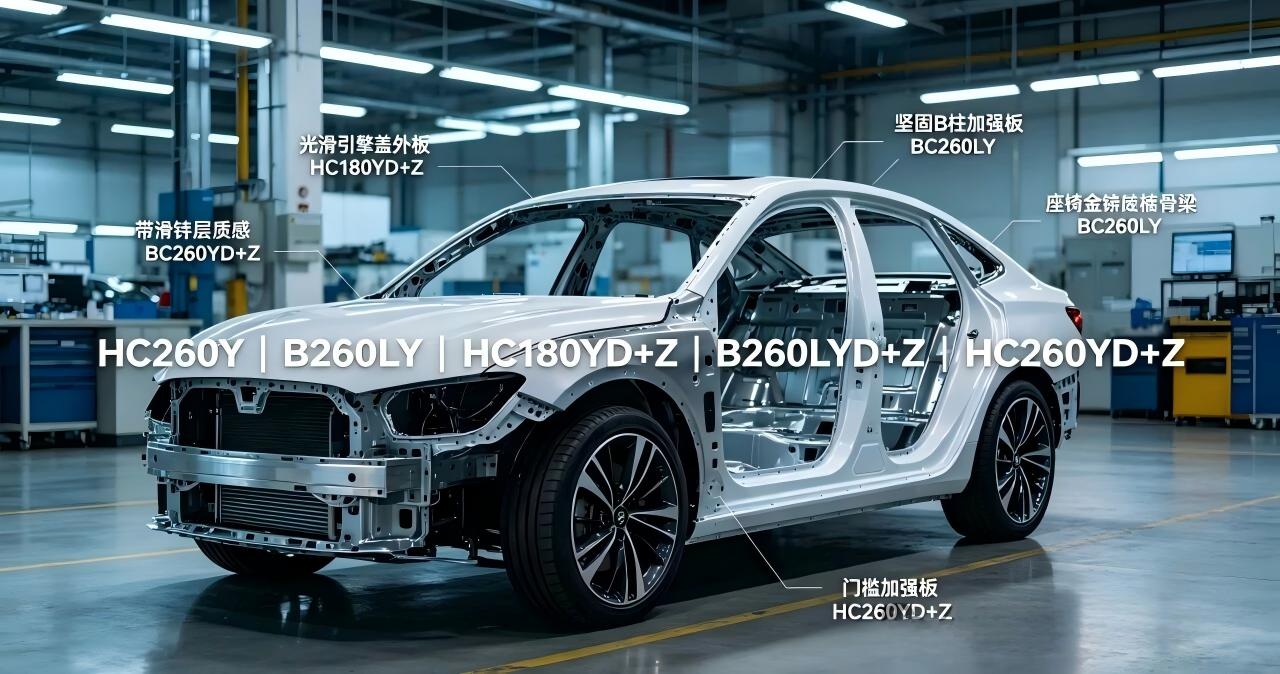
• Outer body panels: B170P1 / HC180Y / HC180YD+Z
Engine hood outer panel, door outer & inner panels, roof panel, fender
• Inner body panels: B210P1 / HC220Y
Dash panel, floor panel, wheel arch inner panel, trunk inner panel
• Structural parts: B250P1 / HC260Y / B260LY
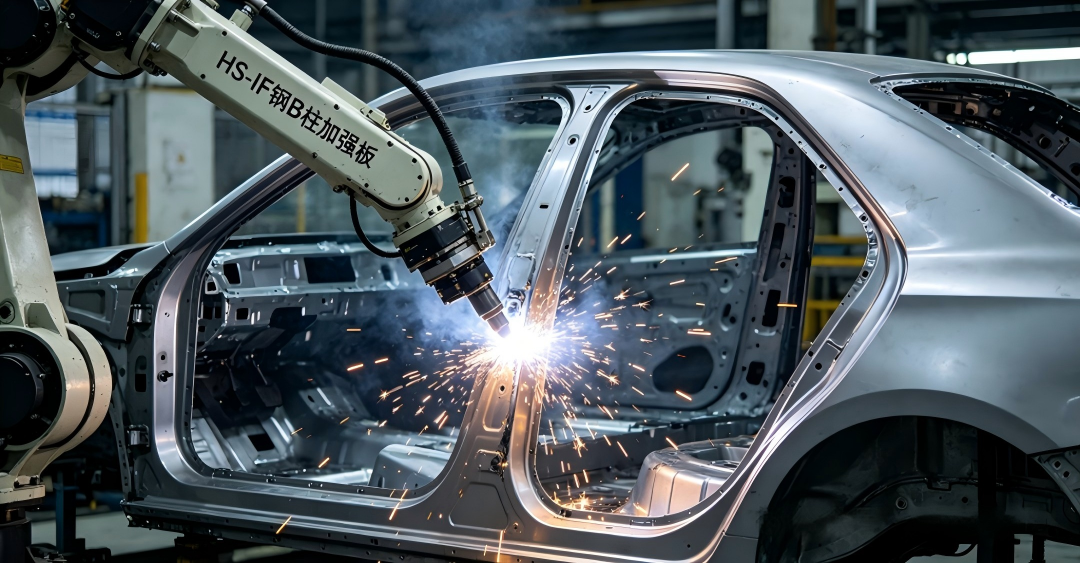
A/B pillar reinforcement, side member, cross member, seat frame, bumper reinforcement beam
Lightweighting Effect
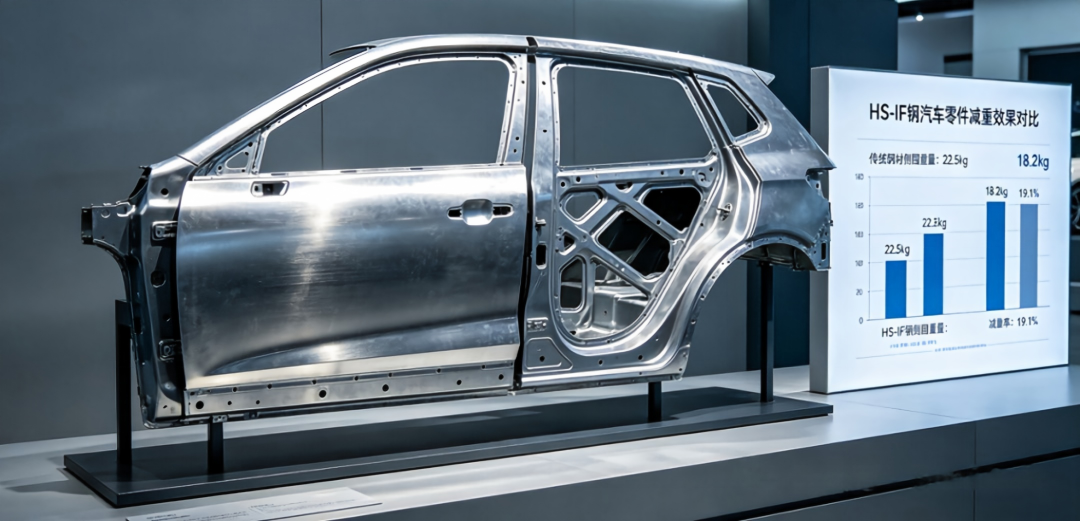
Compared with conventional low-carbon steel, HS-IF steel enables a thickness reduction of 10%–20%, cutting single-part weight by 0.3–0.8 kg and lowering costs by approximately 5%. It is currently the most cost-effective lightweighting solution available.
Specific Vehicle Application Locations (Classified by System)
(1) Body Panel System
• Outer body panels: B170P1 / HC180Y / HC180YD+Z
Engine hood outer panel, trunk lid outer panel, roof panel, fender, side outer panel, door outer panel
• Inner body panels: B210P1 / HC220Y
Engine hood inner panel, trunk lid inner panel, door inner panel, dash panel, floor panel, wheel arch inner panel
(2) Body Structural Component System
• Front body structure: B250P1 / HC260Y
Front side member reinforcement, front cross member, radiator support bracket
• Middle body structure: B250P1 / HC260Y / B260LY
A-pillar reinforcement, B-pillar reinforcement, rocker inner panel, floor cross member
• Rear body structure: B210P1 / HC220Y
Rear side member, rear end panel, trunk floor panel
(3) Other Systems
• Chassis system: B250P1 / HC260Y
Suspension bracket, subframe reinforcement plate
• Seat system: B260LY / HC260YD+Z
Seat frame, seat slide rail
• Crash protection system: B260LY / HC260YD+Z
Bumper reinforcement beam, door impact beam
Application Cases & Lightweighting Benefits
• Case 1: For a joint-venture A-class sedan, the door inner panel material was switched from DC04 to B210P1; sheet thickness was reduced from 0.8 mm to 0.7 mm. Single-part weight cut by 0.3 kg, total vehicle weight reduced by 1.2 kg, with around 5% lower material cost.
• Case 2: For a domestic brand SUV, the B-pillar reinforcement was upgraded from B210P1 to HC260Y; thickness decreased from 1.2 mm to 1.0 mm. Single-part weight saved by 0.8 kg, while side impact safety performance was improved simultaneously.
• Overall performance: HS-IF steel delivers a 10%~20% weight reduction compared with conventional low-carbon steel, making it the most cost-effective solution for automotive lightweighting at present.
六、CAE Simulation Application
The extensive application of HS-IF steel relies heavily on CAE simulation technology. Accurate material models and parameters are the core guarantee of simulation precision.
1. Stamping Forming Simulation
• Software: AutoForm, Dynaform, LS-DYNA
• Recommended material models: MAT37 (basic), MAT125 (high-precision)
• Key parameters: True stress-strain curve, r-values & n-values in three directions, Forming Limit Diagram (FLD)
• Applications: Drawbead design, blank holder force optimization, wrinkle & crack prediction, springback compensation
2. Crash Safety Simulation
• Software: LS-DYNA, PAM-CRASH
• Recommended material models: MAT24 (basic), MAT123 (damage-enabled)
• Key parameters: Static & dynamic stress-strain curves, Cowper-Symonds parameters (C=40.4s⁻¹, P=5)
• Applications: Frontal / side / rear crash simulation, pedestrian protection analysis
3. Key Points for Improving Simulation Accuracy
• Actual measured material data shall be adopted instead of directly using standard nominal values.
• Take the influence of stamping history on material properties into account (thickness thinning, work hardening).
• Separate modeling shall be conducted for galvanized steel sheets, whose friction coefficients differ from those of cold-rolled bare steel.
• ACM or FASTENER models shall be adopted for spot welds.
Summary
With the perfect balance of deep drawability, superior surface quality and mechanical strength, HS-IF steel accounts for 30%~40% of the total steel consumption of automobile bodies, making it an irreplaceable core material for vehicle bodies.
At present, HS-IF steel is evolving toward higher strength grades. Baosteel has developed grades such as HC300Y and HC340Y. In the future, HS-IF steel will be used in conjunction with DP steel and TRIP steel to form a more optimized automotive body material system.
Core Conclusion: HS-IF steel is the only grade capable of simultaneously meeting three requirements: complex shape stamping, high surface quality standards and moderate load-bearing capacity, which makes it irreplaceable by any other steel type.


